Question
If $3\cot\theta=4,$ show that $\frac{(1-\tan^2\theta)}{(1+\tan^2\theta)}=\big(\text{cos}^2\theta-\sin^2\theta\big).$
Answer


$3\cot\theta=4\Rightarrow\cot\theta=\frac43\Rightarrow\tan\theta=\frac34$
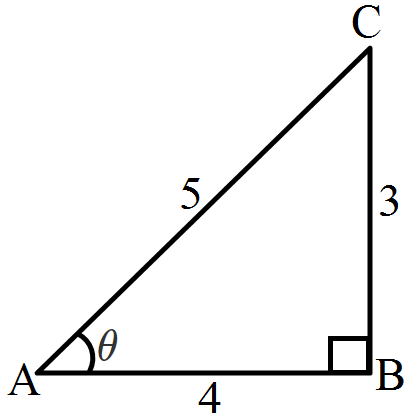
Consider $\triangle\text{ABC},$ where $\angle\text{B}=90^\circ$ and $\angle\text{A}=\theta$
Then, $\cot\theta=\frac{\text{Base}}{\text{Perpendicular}}=\frac{\text{AB}}{\text{BC}}=\frac43$
Let AB = 4 and BC = 3
Then, by pythagoras theoram,
$\text{AC}^2 = \text{AB}^2 + \text{BC}^2$
$=4^3+3^2=16+9=25$
$\Rightarrow\text{AC} = 5$
Now,
$\sin\theta=\frac{\text{Perpendicular}}{\text{Hypotenuse}}=\frac{\text{BC}}{\text{AC}}=\frac35$
$\cos\theta=\frac{\text{Base}}{\text{Hypotenuse}}=\frac{\text{AB}}{\text{AC}}=\frac45$
$\therefore\text{L.H.S.}=\frac{\big(1-\tan^2\theta\big)}{\big(1+\tan^2\theta\big)}$
$=\frac{1-\big(\frac{3}{4}\big)^2}{1+\big(\frac{3}{4}\big)^2}$
$=\frac{1-\frac{9}{16}}{1+\frac{9}{16}}=\frac{\frac{8}{16}}{\frac{25}{16}}=\frac{8}{25}$
$\text{R.H.S.}=\cos^2\theta-\sin^2\theta=\Big(\frac45\Big)^2=\Big(\frac{3}{5}\Big)^2$
$=\frac{16}{25}-\frac{9}{25}=\frac{8}{25}$
Hence, $\frac{(1-\tan^2\theta)}{(1+\tan^2\theta)}=\big(\text{cos}^2\theta-\sin^2\theta\big).$

Need a full question paper?

Generate a complete, print-ready paper with questions like this in minutes — across 16+ boards, with answer keys.

Start Generating Free

Similar questions

Compute the meanof the following data using direct method:
Class
0-100
100-200
200-300
300-400
400-500
Frequency
6
9
15
12
8
In the given figure, D is the midpoint of side BC and $\text{AE}\perp\text{BC}.$ If BC = a, AC = b, AB = c, ED = x, AD = p and AE = h, prove that.
$\text{c}^2=\text{p}^2-\text{ax}+\frac{\text{a}^2}{4}$
Prove that the opposite sides of a quadrilateral circumscribing a circle subtend supplementary angles at the centre of the circle.
Construct a triangle similar to a given $\triangle\text{ABC}$ such that each of its sides is $\Big(\frac{5}{7}\Big)^{\text{th}}$ of the corresponding sides of $\triangle\text{ABC}.$ It is given that AB - 5cm, BC = 7cm and $\angle\text{ABC} = 50^\circ.$
In the given figure, $\angle\text{ABC}=90^\circ$ and $\text{BD}\perp\text{AC}.$ If BD = 8cm, AD = 4cm, find CD.
Solve for x and y:
$\frac{5}{\text{x}}-\frac{3}{\text{y}}=1,$
$\frac{3}{\text{2x}}+\frac{2}{\text{3y}}=\text{5}$ $(\text{x}\neq0,\ \text{y}\neq0).$
Amita buys some books for ₹1920. If she had bought 4 more books for the same amount each book would cost her ₹ 24 less. How many books did she buy? What was the initial price of one book?
A cylindrical container of radius 6cm and height 15cm is filled with ice cream. The whole ice cream has to be distributed to 10 children in equal cones with hemispherical tops. If the height of the conical portion is 4 times the radius of its base, find the radius of the ice cream cone.
Solve for $x$ :
$\frac{2}{x+1}+\frac{3}{2(x-2)}=\frac{23}{5 x}, x \neq 0,-1,2$
The radius of the base of a right circular cone of semi-vertical angle α is r. Show that its volume is $\pi\text{r}^2 \cot\ \text{a}$ and curved surface area is $\pi\text{r}^2\text{cosec a}.$