Question
If $3\cot\theta=4,$ show that $\frac{(1-\tan^2\theta)}{(1+\tan^2\theta)}=\big(\text{cos}^2\theta-\sin^2\theta\big).$

Answer


$3\cot\theta=4\Rightarrow\cot\theta=\frac43\Rightarrow\tan\theta=\frac34$
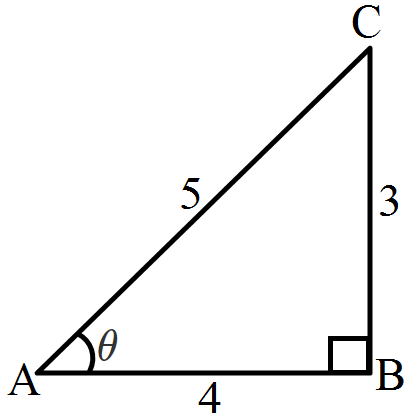
Consider $\triangle\text{ABC},$ where $\angle\text{B}=90^\circ$ and $\angle\text{A}=\theta$
Then, $\cot\theta=\frac{\text{Base}}{\text{Perpendicular}}=\frac{\text{AB}}{\text{BC}}=\frac43$
Let AB = 4 and BC = 3
Then, by pythagoras theoram,
$\text{AC}^2 = \text{AB}^2 + \text{BC}^2$
$=4^3+3^2=16+9=25$
$\Rightarrow\text{AC} = 5$
Now,
$\sin\theta=\frac{\text{Perpendicular}}{\text{Hypotenuse}}=\frac{\text{BC}}{\text{AC}}=\frac35$
$\cos\theta=\frac{\text{Base}}{\text{Hypotenuse}}=\frac{\text{AB}}{\text{AC}}=\frac45$
$\therefore\text{L.H.S.}=\frac{\big(1-\tan^2\theta\big)}{\big(1+\tan^2\theta\big)}$
$=\frac{1-\big(\frac{3}{4}\big)^2}{1+\big(\frac{3}{4}\big)^2}$
$=\frac{1-\frac{9}{16}}{1+\frac{9}{16}}=\frac{\frac{8}{16}}{\frac{25}{16}}=\frac{8}{25}$
$\text{R.H.S.}=\cos^2\theta-\sin^2\theta=\Big(\frac45\Big)^2=\Big(\frac{3}{5}\Big)^2$
$=\frac{16}{25}-\frac{9}{25}=\frac{8}{25}$
Hence, $\frac{(1-\tan^2\theta)}{(1+\tan^2\theta)}=\big(\text{cos}^2\theta-\sin^2\theta\big).$

Need a full question paper?

Generate a complete, print-ready paper with questions like this in minutes — across 16+ boards, with answer keys.

Start Generating Free

Similar questions

A reservoir in the form of the frustum of a right circular cone contains $44 \times 10^7$​​​​​​​ litres of water which fills it completely. The radii of the bottom and top of the reservoir are $50$ metres and $100$ metres respectively. Find the depth of water and the lateral surface area of the reservoir.
Solve the following system of equations by the method of cross-multiplication:
$6(ax + by) = 3a + 2b$
$6(bx - ay) = 3b - 2a$
Determine graphically the coordinates of the vertices of a triangle, the equations of whose sides are:
y = x, y = 2x and y + x = 6.
Using the determinants given below form two linear equations and solve them.
$D=\left|\begin{array}{cc}5 & 7 \\ 2 & -3\end{array}\right| \quad D y=\left|\begin{array}{cc}5 & 4 \\ 2 & -10\end{array}\right|$
In an A.P. $t _{10}=57$ and $t _{15}=87$ then find $t _{21}$.
Solve the following quadratic equations by factorization:
$4x^2 + abx - (a^2 - b^2) = 0$
For the given trading chain prepare the tax invoice I, II, III. GST at the rate of 12% was charged for the article supplied.

(1) Prepare the statement of GST payable under each head by the wholesaler, distributor and retailer at the time of filing the return to the government.
(2) At the end what amount is paid by the consumer?
(3) Write which of the invoices issued are B2B and B2C?
Prove that, the sum of the squares of the diagonals of a rhombus is equal to the sum of the squares of the sides.
Solve the following systems of equations:
$\frac{44}{\text{x}+\text{y}}+\frac{30}{\text{x}-\text{y}}=10,$
$\frac{55}{\text{x}+\text{y}}+\frac{40}{\text{x}-\text{y}}=13.$
Show that the points A(3, 0), B(4, 5), C(-1, 4) and D(-2, -1) are the vertices of a rhombus. Find its area.