Question
If $\frac{4}{5},\text{a},2$ are in AP, find the value of a.

Answer

If $\frac{4}{5},\text{a}$ and 2 are three consecutive terms of an AP, then we have:
$\text{a}-\frac{4}{5}=2-\text{a}$
$\Rightarrow2\text{a}=2+\frac{4}{5}$
$\Rightarrow2\text{a}=\frac{14}{5}$
$\Rightarrow\text{a}=\frac{7}{5}$

Need a full question paper?

Generate a complete, print-ready paper with questions like this in minutes — across 16+ boards, with answer keys.
Start Generating Free

Similar questions

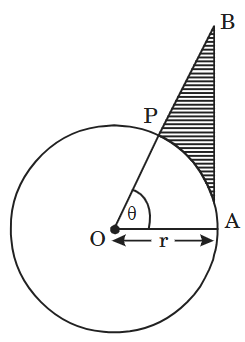
In the given figure, is shown a sector $OAP$ of a circle with centre $O$, containing $\angle \theta . AB$ is perpendicular to the radius $O A$ and meets $O P$ produced at B. Prove that the perimeter of shaded region is $r\left[\tan \theta+\sec \theta+\frac{\pi \theta}{180}-1\right]$
Image
Solve the following quadratic equations by factorization:
$\frac{\text{x}+3}{\text{x}+2}=\frac{3\text{x}-7}{2\text{x}-3}$
The area of a circular playground is $22176\ m^2$. Find the cost of fencing this ground at the rate of $Rs. 50$ per metre.
Find the sum of n terms of an A.P. whose nth terms is given by an = 5 - 6n.
The midpoint of the line segment joining A(2a, 4) and B(-2, 3b) is C(1, 2a + 1). Find the values of a and b.
Find the arithmetic mean of each of the following frequency distributions using step-deviation method:
Class
500-520
520-540
540-560
560-580
580-600
600-620
Frequency
14
9
5
4
3
5
Solve the following quadratic equation:
$\frac{\text{x}-1}{\text{x}-2}+\frac{\text{x}-3}{\text{x}-4}=3\frac{1}{3},$ $\text{x}\neq2,4$
Four points A(6, 3), B(-3, 5), C(4, -2) and D(x, 3x) are given in such a way that $\frac{\triangle\text{DBC}}{\triangle\text{ABC}}=\frac{1}{2},$ find x.
The mean of the following frequency distribution is 18. The frequency f in the class interval 19-21 is missing. Determine f.
Class interval11-1313-1515-1717-1919-2121-2323-25
Frequency36913f54
Find the sum of the following arithmetic progressions:$\frac{\text{x}-\text{y}}{\text{x}+\text{y}}\frac{3\text{x}-2\text{y}}{\text{x}+\text{y}}\frac{5\text{x}-3\text{y}}{\text{x}+\text{y}}, .....\text{ to n terms.}$