If $50$ joule of work must be done to move an electric charge of $2 \,C$ from a point, where potential is $-10$ volt to another point, where potential is $V$ volt, the value of $V$ is ......... $V$
Easy
Download our app for free and get started
(c)
$50=2(V-(-10))$
$25=V+10$
$V=15 \,V$

Download our appand get started for free
Experience the future of education. Simply download our apps or reach out to us for more information. Let's shape the future of learning together!No signup needed.*
Similar Questions
- 1A conducting sphere of radius $10\, cm$ is charged $10\,\mu \,C$. Another uncharged sphere of radius $20\, cm$ is allowed to touch it for some time. After that if the sphere are separated, then surface density of charges, on the spheres will be in the ratio ofView Solution
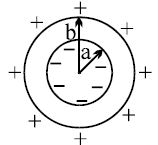
- 2An empty thick conducting shell of inner radius $a$ and outer radius $b$ is shown in figure.If it is observed that the inner face of the shell carries a uniform charge density $-\sigma$ and the surface carries a uniform charge density $ '\sigma '$View Solution
If a point charge $q_A$ is placed at the center of the shell, then choose the correct statement $(s)$
- 3The plates of a capacitor are charged to a potential difference of $320 \, volts$ and are then connected across a resistor. The potential difference across the capacitor decays exponentially with time. After $1 $ second the potential difference between the plates of the capacitor is $240 \, volts$, then after $2$ and $3$ seconds the potential difference between the plates will beView Solution
- 4The plates of parallel plate capacitor are charged upto $100\;V$. A $2\,mm$ thick plate is inserted between the plates. Then to maintain the same potential difference, the distance between the plates is increased by $1.6\;mm$. The dielectric constant of the plate isView Solution
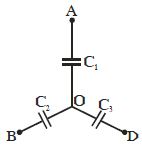
- 5Three uncharged capacitors of capacitance $C_1$, $C_2$ and $C_3$ are connected as shown in figure to one another and to points $A$, $B$ and $D$ at potentials $V_A$, $V_B$ and $V_D$. Then the potential at $O$ will beView Solution
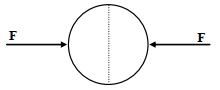
- 6A uniformly charged thin spherical shell of radius $\mathrm{R}$ carries uniform surface charge density of $\sigma$ per unit area. It is made of two hemispherical shells, held together by pressing them with force $\mathrm{F}$ (see figure). $\mathrm{F}$ is proportional toView Solution
- 7Two charges of magnitude $+ q$ and $-\,3q$ are placed $100\,cm$ apart. The distance from $+ q$ between the charges where the electrostatic potential is zero is.......$cm$View Solution
- 8Assertion $(A):$ A spherical equipotential surface is not possible for a point charge.View Solution
Reason $(R):$ A spherical equipotential surface is possible inside a spherical capacitor.
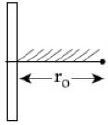
- 9A positive point charge is released from rest at a distance $r_0$ from a positive line charge with uniform density. The speed $(v)$ of the point charge, as a function of instantaneous distance $r$ from line charge, is proportional toView Solution
- 10This question has Statement $1$ and Statement $2$. Of the four choices given after the Statements, choose the one that best describes the two Statements.View Solution
Statement $1$ : It is not possible to make a sphere of capacity $1$ farad using a conducting material.
Statement $2$ : It is possible for earth as its radius is $6.4\times10^6\, m$