If $50$ joule of work must be done to move an electric charge of $2 \,C$ from a point, where potential is $-10$ volt to another point, where potential is $V$ volt, the value of $V$ is ......... $V$
Easy


Download our appand get started for free
Experience the future of education. Simply download our apps or reach out to us for more information. Let's shape the future of learning together!No signup needed.*
Similar Questions
- 1For equal point charges $Q$ each are placed in the $xy$ plane at $(0, 2), (4, 2), (4, -2)$ and $(0, -2)$. The work required to put a fifth change $Q$ at the origin of the coordinate system will beView Solution
- 2Two charged parallel plate capacitors, each with separation between plates equal to $d$, are separated by a large distance $L >> d$. Then the force of interaction between them is proportional toView Solution
- 3Two spheres $A$ and $B$ of radius $a$ and $b$ respectively are at same electric potential. The ratio of the surface charge densities of $A$ and $B$ isView Solution
- 4In free space, a particle $A$ of charge $1\,\mu C$ is held fixed at a point $P.$ Another particle $B$ of the same charge and mass $4\,\mu g$ is kept at a distance of $1\,mm$ from $P$. If $B$ is released, then its velocity at a distance of $9\,mm$ from $P$ is [ Take $\frac{1}{{4\pi {\varepsilon _0}}} = 9 \times {10^9}\,N{m^2}{C^{ - 2}}$ ]View Solution
- 5View SolutionAn uncharged capacitor is connected to a battery. On charging the capacitor
- 6A parallel plate capacitor with air between the plates has capacitance of $9\ pF$. The separation between its plates is '$d$'. The space between the plates is now filled with two dielectrics. One of the dielectrics has dielectric constant $k_1 = 3$ and thickness $\frac{d}{3}$ while the other one has dielectric constant $k_2 = 6$ and thickness $\frac{2d}{3}$ . Capacitance of the capacitor is now.......$pF$View Solution
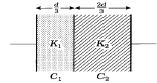
- 7An infinite number of charges each equal to $0.2\,\mu C$ are arranged in a line at distances $1\,m, 2\,m, 4\,m, 8\,m......$ from a fixed point. The potential at fixed point is ......$kV$View Solution
- 8A point charge $Q$ is placed in uniform electric field $\vec E = E_1 \hat i + E_2\hat j$ at position $(a, b)$. Find work done in moving it to position $(c, d)$View Solution
- 9Two parallel plate capacitor with different plate seperation but the same capacitance are connected in series to a battery. Both capacitors are filled with air. The quantity that is $NOT$ the same for both the capacitors when they are fully charged isView Solution
- 10In Millikan's experiment, an oil drop having charge $q$ gets stationary on applying a potential difference $V$ in between two plates separated by a distance $d$. The weight of the drop isView Solution