Question
If A = {1, 2, 3}, B = {3, 4} and C = {4, 5, 6}, find
$\text{A}\times(\text{B}\cup\text{C})$

Answer

We have,
$\text{A}=\{1,2,3\},\text{ B}=\{3,4\}$ and $\text{C}=\{4,5,6\}$
$\therefore\ \text{B}\cup\text{C}=\{3,4\}\cup\{4,5,6\}=(3,4,5,6)$
$\therefore\ \text{A}\times(\text{B}\cup\text{C})=\{1,2,3\}\times\{3,4,5,6\}$
$=\{(1, 3), (1, 4), (1, 5), (1, 6), (2, 3), (2 ,4), (2, 5), (2, 6), (3, 3),(3, 4), (3 ,5), (3, 6)\}$

Need a full question paper?

Generate a complete, print-ready paper with questions like this in minutes — across 16+ boards, with answer keys.
Start Generating Free

Similar questions

Show that the product of perpendiculars on the line $\frac{\text{x}}{\text{a}}\cos\theta+\frac{\text{y}}{\text{b}}\sin\theta=1$ from the points $\Big(\sqrt{\text{a}^2-\text{b}^2},0\Big)$ is $\text{b}^2.$
Find the numberof observation lying between $\overline{\text{X}}-\text{M.D. }$and $\overline{\text{X}}+\text{M.D. }$ is the mean deviation from the mean.
$22, 24, 30, 27, 29, 31, 25, 28, 41, 42$
Find the minors and cofactors of elements of the determinant $D=\left|\begin{array}{ccc}2 & -1 & 3 \\ 1 & 2 & -1 \\ 5 & 7 & 2\end{array}\right|$
Find the modulus and argument of the complex number $\frac{1+2 i}{1-3 i}$.
prove that:
$\sin(\text{B}-\text{C})\cos(\text{A}-\text{D})+\sin(\text{C}-\text{A})\cos(\text{B}-\text{D})+\sin(\text{A}-\text{B})\cos(\text{C}-\text{D})=0$
Show that the point $(\text{x},\ \text{y})$ given by $\text{x}=\frac{2\text{at}}{1+\text{t}^2}$ and $\text{y}=\text{a}\Big(\frac{1-\text{t}^2}{1+\text{t}^2}\Big)$2 lies on a circle for all real values of t such that $-1\leq\text{t}\leq1,$ where a is any given real number.
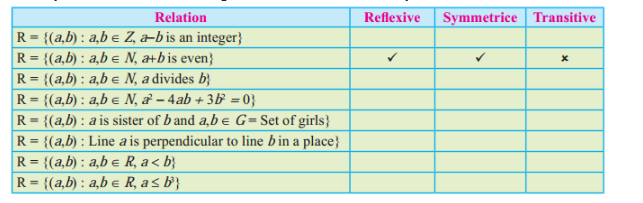
Identify which of the following relations are reflexive, symmetric, and transitive.

Image

Evaluate the following limit:
$\lim\limits_{\text{x}\rightarrow{\frac{\pi}{4}}}\frac{\cos\text{x}-\sin\text{x}}{\big(\frac\pi4-\text{x}\big)(\cos\text{x}+\sin\text{x})}$
If $A=\left[\begin{array}{cc}\cos \theta & \sin \theta \\ -\sin \theta & \cos \theta\end{array}\right]$, prove that $\mathrm{A}^n=\left[\begin{array}{cc}\cos n \theta & \sin n \theta \\ -\sin n \theta & \cos n \theta\end{array}\right]$, for all $n \in \mathbb{N}$.
Find the sum of the following series to n terms:
$3 \times 1^2 + 5 \times 2^2 + 7 \times 3^2 + ...$