MCQ
If $A = [1\,2\,3],B = \left[ \begin{array}{l}2\\3\\4\end{array} \right]$ and $C = \left[ {\begin{array}{*{20}{c}}1&5\\0&2\end{array}} \right],$ then which of the following is defined
  • A
    $AC$
  • $BA$
  • C
    $(AB)\,{\rm{. }}C$
  • D
    $(AC)\,.\,B$

Answer

Correct option: B.
$BA$
$BA = {\left[ \begin{array}{l}2\\3\\4\end{array} \right]_{3 \times 1}}\,{[1\,\,2\,\,3]_{1 \times 3}}$
$ = {\left[ {\begin{array}{*{20}{c}}2&4&6\\3&6&9\\4&8&{12}\end{array}} \right]_{3 \times 3}}$
$AB = {[1\,2\,3]_{1 \times 3}}{\left[ \begin{array}{l}2\\3\\4\end{array} \right]_{3 \times 1}} ={[20]_{1 \times 1}}$.
So, $AB$ and $BA$ are defined.

Need a full question paper?

Generate a complete, print-ready paper with questions like this in minutes — across 16+ boards, with answer keys.
Start Generating Free

Similar questions

The minimum area of a triangle formed by any tangent to the ellipse $\frac{{{x^2}}}{{16}} + \frac{{{y^2}}}{{81}} = 1$ and the co-ordinate axes is
The curve described parametrically by $x = {t^2} + t + 1$, $y = {t^2} - t + 1$ represents
If all the words, with or without meaning, are written using the letters of the word $QUEEN$ and are arranged as in English dictionary, then the position of the word $QUEEN$ is
For the every value of $ x$ the function $f(x) = {1 \over {{5^x}}}$ is
Let a triangle $A B C$ be inscribed in the circle $x ^{2}-$ $\sqrt{2}(x+y)+y^{2}=0$ such that $\angle B A C=\frac{\pi}{2}$. If the length of side $A B$ is $\sqrt{2}$, then the area of the $\triangle ABC$ is equal to
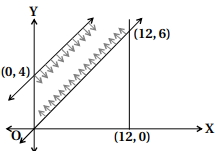
The feasible region for an $LPP$ is shown in the Figure. Let $z=3 x-4 y$ be the objective function.Minimum value of $Z$ is $....$
A normal to the hyperbola, $4x^2 - 9y^2\, = 36$ meets the co-ordinate axes $x$ and $y$ at $A$ and $B$, respectively. If the parallelogram $OABP$ ( $O$ being the origin) is formed, then the locus of $P$ is
Two families with three members each and one family with four members are to be seated in a row. In how many ways can they be seated so that the same family members are not separated ?
If in a parallelogram $ABDC$, the coordinates of $A, B$ and $C$ are respectively $(1, 2), (3, 4)$ and $(2, 5)$, then the equation of the diagonal $AD$ is
Let $f _1: R \rightarrow R f _2:\left(-\frac{\pi}{2}, \frac{\pi}{2}\right) \rightarrow R , f _3:\left(-1, e ^{\frac{\pi}{2}}-2\right) \rightarrow R$ and $f _4: R \rightarrow R$ be functions defined by
$(i)$ $f _1(x)=\sin \left(\sqrt{1- e ^{-x^2}}\right)$
$(ii)$ $f_2(x)=\left\{\begin{array}{ll}\frac{|\sin x|}{\tan ^{-1} x} & \text { if } x \neq 0 \\ 1 & \text { if } x=0\end{array}\right.$, where the inverse trigonometric function of $\tan ^{-1} x$
assume values in $\left(-\frac{\pi}{2}, \frac{\pi}{2}\right)$,
$(iii)$ $f_3(x)=\left[\sin \left(\log _c(x+2)\right)\right]$, where, for $t \in R ,[t]$ denotes the greatest integer less than or equal to $t$,
$(iv) f_4(x)=\left\{\begin{array}{ll}x^2 \sin \left(\frac{1}{x}\right) & \text { if } x \neq 0 \\ 0 & \text { if } x=0\end{array}\right.$
LIST $I$  LIST $ II$ 
$P$ The function $f _1$ is $1\ \text{ NOT}$ continuous at $x=0$
$Q$ The function $f _2$ is $2$ continuous at $x =0$ and $\text{NOT}$ differentiable at $x =0$
$R$ The function $f_3$ is $3$ differentiable at $x=0$ and its derivative is $\text{NOT}$ continuous at $x =0$
$S$ The function $f _4$ is $4$ differentiable at $x =0$ and its derivative is continuous at $x =0$
The correct option is: