Question
If A = 30° and B = 60°, verify that.
$\cos(\text{A}+\text{B})=\cos\text{A}\cos\text{B}-\sin\text{A}\sin\text{B}$

Answer

We have,
$\sin(\text{A}-\text{B})=\frac{1}{2}$ and $\cos(\text{A}+\text{B})=\frac{1}{2}$
Now, $\sin(\text{A}-\text{B})=\frac{1}{2}$
$\Rightarrow\sin(\text{A}-\text{B})=\sin30^\circ$
$\Rightarrow(\text{A}-\text{B})=30^\circ\dots(1)$
And, $\cos(\text{A}+\text{B})=\frac{1}{2}$
$\Rightarrow\cos(\text{A}+\text{B})=\cos60^\circ$
$\Rightarrow(\text{A}+\text{B})=60^\circ\dots(2)$
Adding (1) and (2), we get,
$\Rightarrow2\text{A}=90^\circ$
$\Rightarrow\text{A}=\frac{90^\circ}{2}=45^\circ$
Put $\text{A}=45^\circ$ in (2), we get,
$\Rightarrow45^\circ+\text{B}=60^\circ$
$\Rightarrow\text{B}=60^\circ-45^\circ$
$\Rightarrow\text{B}=15^\circ$
Thus, $\text{A}=45^\circ$ and $\text{B}=15^\circ$

Need a full question paper?

Generate a complete, print-ready paper with questions like this in minutes — across 16+ boards, with answer keys.
Start Generating Free

Similar questions

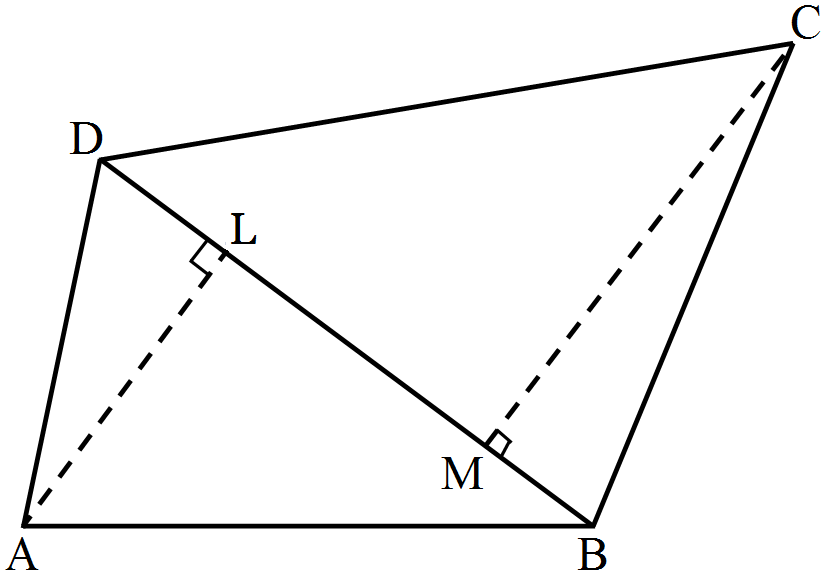
In the given figure, ABCD is a quadrilateral in which diagonal $BD = 24\ cm$, $\text{AL}\perp\text{BD}$ and $\text{CM}\perp\text{BD}$ such that $AL = 9\ cm$ and $CM = 12\ cm$. Calculate the area of the quadrilateral.
Solve the following equations by Cramer’s method.
4m – 2n = –4; 4m + 3n = 16
Find the area of minor segment of a circle of radius 6 cm when its chord subtends an angle of 60° at its centre. $(\sqrt{3}=1.73)$
Marbles of diameter 1.4cm are dropped into a cylindrical beaker of diameter 7cm containing some water. Find the number of marbles that should be dropped into the beaker so that the water level rises by 5.6cm.
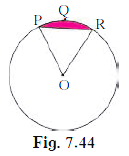
In the figure 7.44, O is the centre of the circle. M (arc PQR) = 60° OP = 10 cm.
Find the area of the shaded region. (π = 3.14, √3 = 1.73)
Find the value of k for which root are real and equal in the following equations:
$(k + 1)x^2 + 2(k + 3)x + (k + 8) = 0$
In a frequency distribution table with 12 classes, the class width is 2.5 and the lowest class boundary is 8.1, then what is the upper class boundary of the highest class?
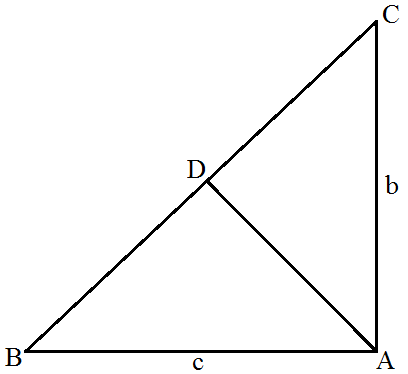
Using Pythagoras theorem determine the length of AD in terms of b and c shown in the given figure.
An army contingent of 616 members is to march behind an army band of 32 members in a parade. The two groups are to march in the same number of columns. What is the maximum number of columns in which they can march?
Find the volume of the largest right circular cone that can be cut out of a cube whose edge is 9cm.