MCQ
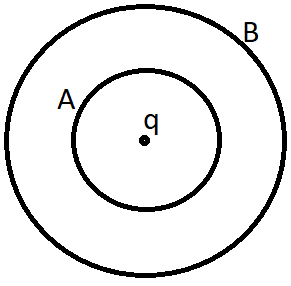
- AIt will remain stationary
- BIt will move from B to A
- CIt will move from A to B
- DIt will rotate in a circular path
Explanation:
A charge always tries to move from a point of higher potential to a point of lower potential. The potential at A is greater than the potential at B because of electric potential decreases with distance from the charge. It can also be explained by the fact that a positive charge is always repelled by another positive charge.
Generate a complete, print-ready paper with questions like this in minutes — across 16+ boards, with answer keys.
A very long straight wire carries a current I. At the instant when a charge +Q at point P has velocity  , as shown, the force on the charge is

|
(a) Opposite to OX |
(b) Along OX |
(c) Opposite to OY |
(d) Along OY |
A piece of fuse wire melts when a current of 15 ampere flows through it. With this current, if it dissipates 22.5 W, the resistance of fuse wire will be
|
(a) Zero |
(b) 10 Ω |
(c) 1 Ω |
(d) 0.10 Ω |
In the arrangement of resistances shown below, the effective resistance between points A and B is

|
(a) 20 Ω |
(b) 30 Ω |
(c) 90 Ω |
(d) 110 Ω |
When a ray of light passes from a denser to a rarer medium, some part of it gets ....... into the denser medium:
A thin glass (refractive index 1.5) lens has optical power of -5D in air. It's optical power in a liquid medium with refractive index 1.6 will be
|
(a) 25 D |
(b) – 25 D |
(c) 1 D |
(d) None of these |
A glass rod rubbed with silk is used to charge a gold leaf electroscope and the leaves are observed to diverge. The electroscope thus charged is exposed to X-rays for a short period. Then
|
(a) The divergence of leaves will not be affected |
|
(b) The leaves will diverge further |
|
(c) The leaves will collapse |
|
(d) The leaves will melt |