MCQ
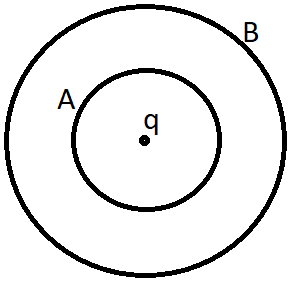
- AIt will remain stationary
- BIt will move from B to A
- CIt will move from A to B
- DIt will rotate in a circular path
Explanation:
A charge always tries to move from a point of higher potential to a point of lower potential. The potential at A is greater than the potential at B because of electric potential decreases with distance from the charge. It can also be explained by the fact that a positive charge is always repelled by another positive charge.
Generate a complete, print-ready paper with questions like this in minutes — across 16+ boards, with answer keys.
Lenz's law gives
|
(a) The magnitude of the induced e.m.f. |
|
(b) The direction of the induced current |
|
(c) Both the magnitude and direction of the induced current |
|
(d) The magnitude of the induced current |
A nucleus of mass 218 amu in free state decays to emit an a-particle. Kinetic energy of the a-particle emitted is 6.7 MeV. The recoil energy (in MeV) of the daughter nucleus is
|
(a) 1.0 |
(b) 0.5 |
(c) 0.25 |
(d) 0.125 |