Question
If $a + b = 7$ and $ab = 10;$ find $a - b.$

Answer

We know that,
$(a+b)^2=a^2+2 a b+b^2$
and
$ (a-b)^2=a^2-2 a b+b^2$
Rewrite the above equation, we have
$(a-b)^2=a^2+b^2-2 a b+4 a b$
$=(a+b)^2-4 a b$
$\ldots(1)$
Given that $a+b=7 ; a b=10$
Substitute the values of $(a+b)$ and $(ab)$ in equation $(1),$ we have
$(a-b)^2 =(7)^2-4(10)$
$ =49-40=9$
$\Rightarrow a-b = \pm \sqrt{9}$
$\Rightarrow a-b = \pm 3$

Need a full question paper?

Generate a complete, print-ready paper with questions like this in minutes — across 16+ boards, with answer keys.
Start Generating Free

Similar questions

Construct a rhombus $\text{ABCD},$ when:Diagonal $AC = 6.3 \ cm$ and diagonal $BD = 5.8 \ cm.$
Find the amount paid by a customer when he buys a watch priced at $Rs. 5400$ available at a discount of $12\%.$
The diameter of a wheel is $1.4\ m.$ How many revolutions does make in moving a distance of $2.2\ km$?
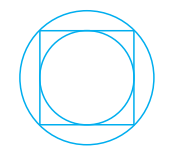
In the figure, a circle is inscribed in a square of side 5 cm and another circle is circumscribing the square. Find the ratio of the area of the outer circle to that of the inner circle.
Image
Amit started a shop by investing ₹500000. In the first year, he incurred a loss of 5%. However, during the second year, he earned a profit of 10% which in the third year rose to 12%. Calculate his net profit for the entire period of three years.
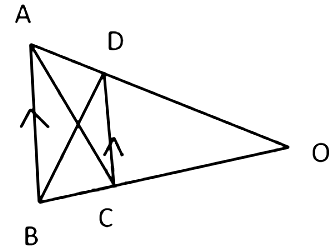
In the following figure, $OAB$ is a triangle and $AB \| DC.$

If the area of $\triangle CAD=140 \ cm^2$ and the area of $\triangle ODC=172\ \ cm^2$, find:$(i)$ the area of $\triangle DBC,(ii)$ the area of $\triangle OAC,(iii)$ the area of $\triangle ODB$.
The radii of two circles are $25 \ cm$ and $18 \ cm$. Find the radius of the circle which has a circumference equal to the sum of circumferences of these two circles.
Using the step-deviation method, find the mean from the following data :
$x_i$18192021222324
$f_i$170320530700230140110
Without using trigonometric tables, find the value of:
$\frac{\tan ^2 60^{\circ}+4 \cos ^2 45^{\circ}+\sec ^2 30^{\circ}+5 \cos ^2 90^{\circ}}{\operatorname{cosec} 30^{\circ}+\sec 60^{\circ}-\cot ^2 30^{\circ}}$
Prove the following: $\sin ^2 30^{\circ}+\cos ^2 30^{\circ}=\frac{1}{2} \sec 60^{\circ}$