Question
If A, B and C are the angle of a $\triangle\text{ABC},$ prove that $\tan\Big(\frac{\text{C+A}}{2}\Big)=\cot\frac{\text{B}}{2}.$

Answer

In $\triangle\text{ABC},$
$\text{A}+\text{B}+\text{C}=180^\circ$
$\Rightarrow\text{A}+\text{C}=180^\circ-\text{B}\dots(\text{i})$
Now,
$\text{L.H.S.}=\tan\Big(\frac{\text{C}+\text{A}}{2}\Big)$
$=\tan\Big(\frac{180^\circ-\text{B}}{2}\Big)$ [Using (i)]
$=\tan\Big(90^\circ-\frac{\text{B}}{2}\Big)$
$=\cot\frac{\text{B}}{2}$
$=\text{R.H.S.}$

Need a full question paper?

Generate a complete, print-ready paper with questions like this in minutes — across 16+ boards, with answer keys.
Start Generating Free

Similar questions

Prove : $\sec \theta+\tan \theta=\frac{1}{\sec \theta-\tan \theta}$
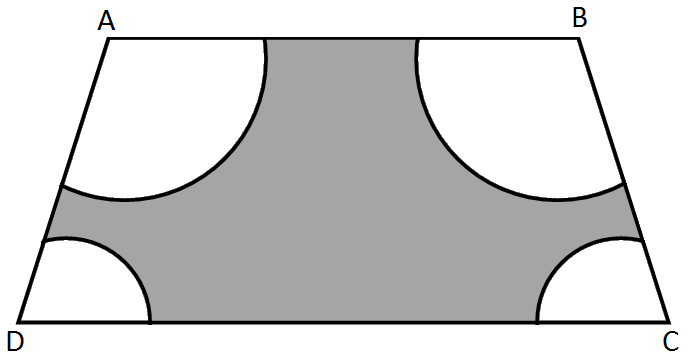
In the given figure, ABCD is a trapezium with $\text{AB}||\text{DC},\text{AB}=18\text{cm}$ DC = 32cm and the distance between AB and DC is 14cm. Circles of equal radii 7cm with centres A, B, C and D have been drawn. Then find the area of the shaded region.$\Big(\text{Use }\pi=\frac{22}{7}\Big)$
D and E are the points on the sides AB and AC respectively of a $\triangle\text{ABC}$ such that:
AD = 8cm, DB = 12cm, AE = 6cm and CE = 9cm, Prove that $\text{BC}=\frac{5}{2}$ DE.
A balloon vendor has 2 red, 3 blue and 4 green balloons. He wants to choose one of them at random to give it to Pranali. What is the probability of the event that Pranali gets,
(i) a red balloon
(ii) a blue balloon. 
Solve the following simultaneous equation graphically.
x – 3y = 1; 3x – 2y + 4 = 0
The interior of a building is in the form of a cylinder of base radius 12m and height 3.5m, surmounted by a cone of equal base and slant height 12.5m. Find the internal curved surface area and the capacity of the building.
Can two numbers have 16 as their H.C.F. and 380 as their L.C.M? Give reason.
If m times the mth term of an A.P. is equal to n times nth term then show that the (m + n)th term of the A.P. is zero.
how many two-digit numbers are divisible by 5?
Activity :- Two-digit numbers divisible by 5 are, 10,15,20........95.
Here, d=5, therefore this sequence is an A.P.
Here a=10, d=5, Tn=95, n=?
$t _{ n }$= a+(n-1____)
____= 10+(n-1)×5
____= (n-1)×5
____= (n-1)
therefore n=____
there are ____two-digit numbers divisible by 5.