MCQ
If  $ a, b, c, d$  are coplanar vectors, then $(a \times b) \times (c \times d) = $
  • A
    $|\,a\, \times \,c{|^2}$
  • B
    $|a \times d{|^2}$
  • C
    $|b \times c{|^2}$
  • $0$

Answer

Correct option: D.
$0$
d
(d) $(a \times b) \times (c \times d) = [a\,b\,d]c - [a\,b\,c]d$

$\because a,b,c,d$ are coplanar vectors

$\therefore \,\,\,[a\,b\,d] = [a\,b\,c] = 0.$ So, $(a \times b) \times (c \times d) = 0$.

Need a full question paper?

Generate a complete, print-ready paper with questions like this in minutes — across 16+ boards, with answer keys.

Start Generating Free

Similar questions

Let $A=\left[\begin{array}{l}a_{1} \\ a_{2}\end{array}\right]$ and $B=\left[\begin{array}{l}b_{1} \\ b_{2}\end{array}\right]$ be two $2 \times 1$ matrices with real entries such that $A = XB,$

where $X=\frac{1}{\sqrt{3}}\left[\begin{array}{cc}1 & -1 \\ 1 & k\end{array}\right],$ and $k \in R$. If $a _{1}^{2}+ a _{2}^{2}=\frac{2}{3}\left( b _{1}^{2}+ b _{2}^{2}\right)$ and $\left( k ^{2}+1\right) b _{2}^{2} \neq-2 b _{1} b _{2}$ then the value of $k$ is ....... .

Let $l = \mathop {Lim}\limits_{x \to {0^ + }} x^m (ln\,\, x)^n$ where $m, n \in N$ then :
If $\left[\begin{array}{cc}1 & -\tan \theta \\ \tan \theta & 1\end{array}\right]\left[\begin{array}{cc}1 & \tan \theta \\ -\tan \theta & 1\end{array}\right]^{-1}=\left[\begin{array}{cc}a & -b \\ b & a\end{array}\right]$, then
Order of $\Big(\frac{\text{dy}}{\text{dx}}+3\text{x}\Big)^\frac{3}{2}=\text{x}+\frac{3\text{dy}}{\text{dx}}$ is:
  1. 3
  2. 2
  3. 1
  4. 4
A flash light has 8 batteries out of which 3 are dead. IF two batteries are selected without replacement and tested, then the probability that both are dead is,
  1. $\frac{3}{28}$
  2. $\frac{1}{14}$
  3. $\frac{9}{64}$
  4. $\frac{33}{56}$
$\lim _{n \rightarrow \infty} \frac{1}{2^{n}}\left(\frac{1}{\sqrt{1-\frac{1}{2^{a}}}}+\frac{1}{\sqrt{1-\frac{2}{2^{n}}}}+\frac{1}{\sqrt{1-\frac{3}{2^{a}}}}+\ldots \ldots+\frac{1}{\sqrt{1-\frac{2^{a}-1}{2^{n}}}}\right)$ is equal to
If $\theta$ is the angle between two vectors $\vec{a}$ and $\vec{b},$ then $\vec{a} \cdot \vec{b} \geq 0$ only when
If $\int\limits^\alpha_0\frac{1}{1+4\text{x}^2}\text{ dx}=\frac{\pi}{8},$ then a equals:

  1. $\frac{\pi}{2}$

  2. $\frac{1}{2}$

  3. $\frac{\pi}{4}$

  4. $1$

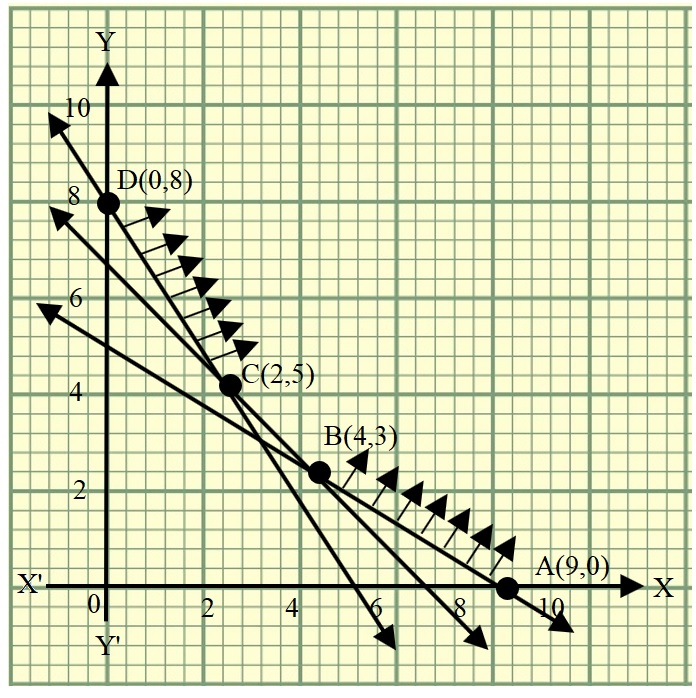
Feasible region (shaded) for a LPP is shown in the given figure. Minimum of z = 4x + 3y occurs at the point.

  1. (0, 8)
  2. (2, 5)
  3. (4, 3)
  4. (9, 0)
If $\int_{}^{} {\frac{{{e^x}(1 + \sin x)dx}}{{1 + \cos x}} = {e^x}f(x) + c} $, then $f(x) = $