MCQ
If a body is charged by rubbing it, its weight:
- AAlways decreases slightly.
- BAlways increases slightly.
- CMay increase slightly or may decrease slightly.
- DRemains precisely the same.
Explanation:
If a body is charged by rubbing it, then it may lose or gain electrons. Since electrons have a mass of (9.1 × 10⁻³¹kg). So, a slight weight may increase or decrease slightly.
Generate a complete, print-ready paper with questions like this in minutes — across 16+ boards, with answer keys.
The figure illustrate how B, the flux density inside a sample of unmagnetised ferromagnetic material varies with B0, the magnetic flux density in which the sample is kept. For the sample to be suitable for making a permanent magnet

|
(a) OQ should be large, OR should be small |
|
(b) OQ and OR should both be large |
|
(c) OQ should be small and OR should be large |
|
(d) OQ and OR should both be small |
Plane figures made of thin wires of resistance R = 50 milli ohm/metre are located in a uniform magnetic field perpendicular into the plane of the figures and which decrease at the rate dB/dt = 0.1 m T/s. Then currents in the inner and outer boundary are. (The inner radius a = 10 cm and outer radius b = 20 cm)
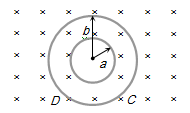
|
(a) 10– 4 A (Clockwise), 2 × 10– 4 A (Clockwise) |
|
(b) 10– 4 A (Anticlockwise), 2 × 10– 4 A (Clockwise) |
|
(c) 2 × 10– 4 A (clockwise), 10– 4 A (Anticlockwise) |
|
(d) 2 × 10– 4 A (Anticlockwise), 10– 4 A (Anticlockwise) |
If scattering particles are 56 for 90° angle then this will be at 60° angle
|
(a) 224 |
(b) 256 |
(c) 98 |
(d) 108 |
A coil having an area  is placed in a magnetic field which changes from
  to
to  in a interval of 2 second. The e.m.f. induced in the coil will be
|
(a) 4 V |
(b) 3 V |
(c) 1.5 V |
(d) 2 V |
$\text{B}_\text{y},=\text{B}_\text{y}+\frac{\text{vE}_\text{z}}{\text{c}^2}$
$\text{E}_\text{y},=\text{E}_\text{y}+\frac{\text{vB}_\text{z}}{\text{c}^2}$
$\text{B}'_\text{y}=\text{B}_\text{y}+\text{v}\text{E}_\text{z}$
$\text{E}'_\text{y}=\text{E}_\text{y}+\text{vB}_\text{z}$
A prism (μ = 1.5) has the refracting angle of 30°. The deviation of a monochromatic ray incident normally on its one surface will be (sin 48° 36’ = 0.75)
|
(a) 18° 36’ |
(b) 20° 30’ |
(c) 18° |
(d) 22°1’ |