MCQ
If a calculated value $2.7465 \,g$ contains only three significant figures, the two insignificant digits in it are ............ 
  • A
    $2$ and $7$
  • B
    $7$ and $4$
  • $6$ and $5$
  • D
    $4$ and $6$

Answer

Correct option: C.
$6$ and $5$
c
(c)

$2.7465 \,g \Rightarrow$ Last two digits are most insignificant

Need a full question paper?

Generate a complete, print-ready paper with questions like this in minutes — across 16+ boards, with answer keys.
Start Generating Free

Similar questions

A perpendicular material is place in a magnetic fields. Consider the following statemetns:
  1. If the magnetic field is increased, the magnetization is increased.
  2. If the temperature is increased, the magnetization is increased.
The number of significant figures in 61,00,000 is:
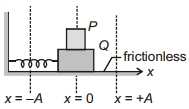
In the figure shown, there is friction between the blocks $P$ and $Q$ but the contact between the block $Q$ and lower surface is frictionless. Initially the block $Q$ with block $P$ over it lies at $x=0$, with spring at its natural length. The block $Q$ is pulled to right and then released. As the spring - blocks system undergoes $S.H.M.$ with amplitude $A$, the block $P$ tends to slip over $Q . P$ is more likely to slip at
A man on a rectilinearly moving cart, facing the direction of motion, throws a ball straight up with respect to himself
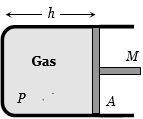
A cylindrical piston of mass $M$ slides smoothly inside a long cylinder closed at one end, enclosing a certain mass of gas. The cylinder is kept with its axis horizontal. If the piston is disturbed from its equilibrium position, it oscillates simple harmonically. The period of oscillation will be
Assuming the sun to have a spherical outer surface of radius $r$, radiating like a black body at temperature $t^o C$, the power received by a unit surface, (normal to the incident rays) at a distance $R$ from the centre of the sun is

where $\sigma$ is the Stefan's constant.

A man standing on the roof of a house of height $h$ throws one particle vertically downwards and another particle horizontally with the same velocity $u$. The ratio of their velocities when they reach the earth's surface will be
The SI units of the universal gravitational constant G are:
A man, of mass $m,$ standing at the bottom of the staircase, of height $L$ climbs it and stands at its top.
A particle moves in $x-y$ plane with velocity $\vec v = a\widehat i\, + \,bx\widehat j$ where $a$ & $b$ are constants. Initially particle was at origin then trajectory equation is:-