MCQ
If a charged particle at rest experiences no electromagnetic force:
  • A
    The electric field must be zero.
  • B
    The magnetic field must be zero.
  • C
    The magnetic field may or may not be zero.
  • A and C both

Answer

Correct option: D.
A and C both
Explanation:
Force on charged particle in an electric eld, $F = qE \ldots (1)$
Force on charged particle in a magnetic eld $F = q ( v \times b )= qvB \sin \theta \ldots (2)$
Where boldface letter represent vector nature of that quantity, $q$ is charge of the particle, $v$ is the velocity of the particle( if any), and $\theta$ is the angle between velocity and magnetic eld.
From (1), $F _{ E }=0$ only when either $q =0$ or $E =0$.
Let $q \neq 0$, and $F \neq 0$, then we must have $E \neq 0$
From (2), if $q \neq 0, v \neq 0$ and $B \neq 0$ even then $F_B$ can be 'zero' because of $\theta=0^{\circ}$ or $180^{\circ}$

Need a full question paper?

Generate a complete, print-ready paper with questions like this in minutes — across 16+ boards, with answer keys.
Start Generating Free

Similar questions

A beam of monochromatic light is used to excite the electron in $Li ^{++}$from the first orbit to the third orbit. The wavelength of monochromatic light is found to be $x \times 10^{-10} \; m$. The value of $x$ is $\dots.$ [Given hc $=1242 \; eV nm ]$
The work done in turning a magnet of magnetic moment 'M' by an angle of 90° from the meridian is 'n' times the corresponding work done to turn it through an angle of 60°, where 'n' is given by
Deviation of 5° is observed from a prism whose angle is small and whose refractive index is 1.5. The angle of prism is
Gauss’s law is true only if force due to a charge varies as
An electron moves with a speed of $2 \times 10^5\, m/s$ along the $+ x$ direction in a magnetic field $\vec B = \left( {\hat i - 4\hat j - 3\hat k} \right)\,tesla$. The magnitude of the force (in newton) experienced by the electron is (the charge on electron $= 1.6 \times 10^{-19}\, C$)
Why does light travel as a wave?
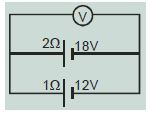
Two batteries, one of $emf$ $18\, volts$ and internal resistance $2\,\Omega $ and the other of $emf$ $12\, volt$ and internal resistance $1\,\Omega $, are connected as shown. The voltmeter $V$ will record a reading of .............. $\mathrm{volt}$
The radius of a wavefront as the waves propagate:
One proton beam enters a magnetic field of ${10^{ - 4}}$ $T$ normally, Specific charge = ${10^{11}}\,C/kg.$ velocity = ${10^7}\,m/s$. What is the radius of the circle described by it....$m$
Two electric charges $12\,\mu C$ and $ - 6\,\mu C$ are placed $20\, cm$ apart in air. There will be a point $P$ on the line joining these charges and outside the region between them, at which the electric potential is zero. The distance of $P$ from $ - 6\,\mu C$ charge is.......$m$