Question
If a compressed spring is dissolved in acid, what happened to the elastic potential energy of the spring?

Answer

When a compressed spring dissolves in an acid, the acid molecules leave the sold lattice of the spring faster than the uncompressed spring. This in turn increases the kinetic energy of the solution. As a result, the temperature of the acid also increases. However, this temperature increase will be very small because the mechanical energy content in the spring is lesser than its chemical energy content.

Need a full question paper?

Generate a complete, print-ready paper with questions like this in minutes — across 16+ boards, with answer keys.

Start Generating Free

Similar questions

Provide the classification of semi-conductors with example.
Assume that the magnetic field is uniform in a cubical region and is zero outside. Can you project a charged particle from outside into the field so that the particle describes a complete circle in the field?
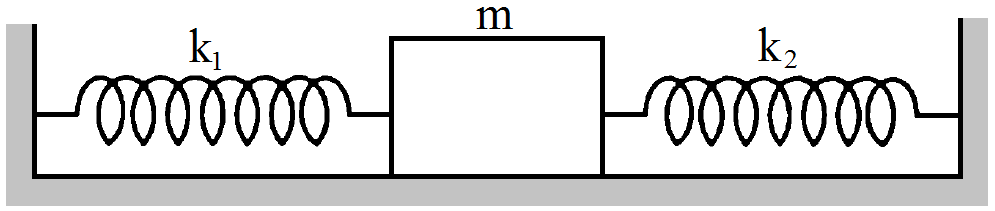
A block of mass $m$ is attached to two unstretched springs of spring constants $k_1$ and $k_2$ as shown in figure. The block is displaced towards right through a distance $x$ and is released. Find the speed of the block as it passes through the mean position shown.
A spherical conducting shell of inner radius $r_1$ and outer radius $r_2$ has a charge ‘Q’. A charge ‘q’ is placed at the centre of the shell.
  1. What is the surface charge density on the (i) inner surface, (ii) outer surface of the shell?
  2. Write the expression for the electric field at a point $x > r_2$ from the centre of the shell.
Give explanation of linearly pofarized, unpolarized and plane polarized wave.
Calculate the mass of an $\alpha$-particle. Its binding energy is 28.2MeV.
What is the resistance of an intrinsic semiconductor at 0K?
In a long straight wire, a current of 5 A is flowing. How much magnetic field will be produced at a distance of 10 cm from it? Which rule will give the direction of the field?
Three sources of sound $S_1, S_2$ and $S_3$ of equal intensity are placed in a straight line with $\mathrm{S}_1 \mathrm{~S}_2=\mathrm{S}_2 \mathrm{~S}_3$ figure. At a point $P$, far away from the sources, the wave coming from $S$ is $120^{\circ}$ ahead in phase of that from $S_1$. Also, the wave coming from $\mathrm{S}_3$ is $120^{\circ}$ ahead of that from $\mathrm{S}_2$. What would be the resultant intensity of sound at P ?
Figure. shows a cylindrical tube of cross-sectional area A fitted with two frictionless pistons. The pistons are connected to each other by a metallic wire. Initially, the temperature of the gas is $T_0$ and its pressure is P, which equals the atmospheric pressure. (a) What is the tension in the wire? (b) What will be the tension if the temperature is increased to $2T_0?$​​​​​​​