MCQ
If $a$ cylinder is rolling down the incline with sliding.
  • A
    after some time it may start pure rolling
  • B
    after sometime it will start pure rolling
  • C
    it may be possible that it will never start pure rolling
  • Both $(A)$ and $(C)$

Answer

Correct option: D.
Both $(A)$ and $(C)$
d
It is the frictional force which is responsible for rolling of the body. If initially the speed of the body is high as compared to the frictional force the body would slide without rolling, Afterwards the frictional force may come into action when the rolling would start.

Need a full question paper?

Generate a complete, print-ready paper with questions like this in minutes — across 16+ boards, with answer keys.
Start Generating Free

Similar questions

Rate of cooling at $600K$ , if surrounding temperature is $300K$ is $R$ . The rate of cooling at $900K$ is
Two stationary sources each emitting waves of wave length $\lambda$. An observer moves from one source to other with velocity $u .$ Then number of beats heared by him
A metallic rod of cross-sectional area $9.0\,\,cm^2$ and length $0.54 \,\,m$, with the surface insulated to prevent heat loss, has one end immersed in boiling water and the other in ice-water mixture. The heat conducted through the rod melts the ice at the rate of $1 \,\,gm$ for every $33 \,\,sec$. The thermal conductivity of the rod is ....... $ Wm^{-1} K^{-1}$
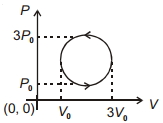
A thermodynamic system is taken through cyclic process. The total work done in the process is $.........\,J$
A sphere is rolled on a rough horizontal surface. It gradually slows down and stops. The force of friction tries to:
Two particles are projected from the same point with the same speed $u$ such that they have the same range $R$, but different maximum heights, $h_1$ and $h_2$. Which of the following is correct ?
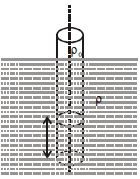
A solid cylinder of density $\rho_0$, cross-section area $A$ and length $l$ floats in a  liquid $\rho(> \rho_0)$ with its axis vertical, as shown. If it is slightly displaced downward  and released, the time period will be 
A car is standing $200\, m$ behind a bus, which is also at rest. The two start moving at the same instant but with different forward accelerations. The bus has acceleration $2\,m/s^2$ and the car has acceleration $4\, m/s^2$ . The car will catch up with the bus after a time of
Heat is being supplied at a constant rate to a sphere of ice which is melting at the rate of $0.1 \,\,gm/sec$. It melts completely in $100\,\,sec$. The rate of rise of temperature thereafter will be ........$^oC/\sec$ (Assume no loss of heat.)
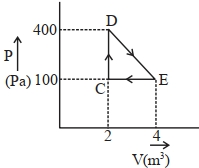
Work done in the cyclic process shown in figure is ...........