Question
If a hexagon ABCDEF circumscribe a circle, prove that AB + CD + EF = BC + DE + FA.

Answer

Given: A circle inscribed in a hexagon ABCDEF.
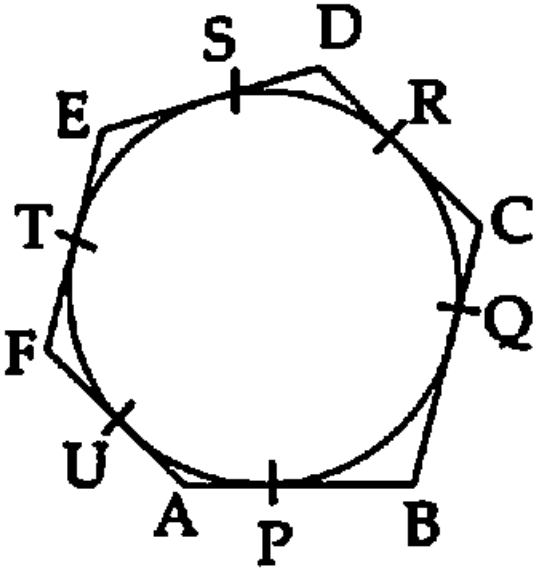
Sides, AB, BC, CD, DE and DF touches the circle at P, Q, R, S, T and U respectively.
To prove: AB + CD + EF = BC + DE + FA
Proof: We know that tangents from an external point to a circle are equal.
Here, vertices of hexagon are outside the circle so
AP = AU
BP = BQ
CQ = CR
DR = DS
ES = ET
FT = FU
LHS = AB + CD + EF = (AP + PB) + (DR + CR) + (ET + TF)
By using above results, we have
LHS = AB + CD + EF = AU + BQ + DS + CQ + ES + FU
= AU + FU + BQ + CQ +DS + ES
= AF + BC + DE.
Hence, proved.
Need a full question paper?

Generate a complete, print-ready paper with questions like this in minutes — across 16+ boards, with answer keys.

Start Generating Free

Similar questions

The difference between the sides at right angle in a right-angled triangle is 7cm. The area of the triangle is $60cm^2.$ Find its perimeter.
Solve the following quadratic equations by factorization:
$\frac{\text{x}-\text{a}}{\text{x}-\text{b}}+\frac{\text{x}-\text{b}}{\text{x}-\text{a}}=\frac{\text{a}}{\text{b}}+\frac{\text{b}}{\text{a}}$
If $\text{x}=\frac{2}{3}$ and x = -3 are the roots of the equation $ax^2 + 7x + b = 0$, find the values of a and b.
The angle of elevation of the top of a tower 30m high from the foot of another tower in the same plane is 60° and the angle of elevation of the top of the second tower from the foot of the first tower is 30°. Find the distance between the two towers and also the height of the other tower.
4 tables and 3 chairs, together, cost Rs. 2250 and 3 tables and 4 chairs cost Rs. 1950. Find the cost of 2 chairs and 1 table.
Find the roots of the following equations, if they exist, by applying the quadratic formula:$\text{x}^2-(\sqrt3+1)\text{x}+\sqrt3=0$
Find the perimeter and area of the quadrilateral ABCD in which AB = 17cm, AD = 9cm, CD = 12cm, $\angle\text{ACB} = 90^\circ$ and AC = 15cm.
Solve for x and y:
$x + y = a + b,$
$ax - by = a^2 - b^2$
Find the ratio in which the line segment joining (-2, -3) and (5, 6) is divided by (i) x-axis (ii) y-axis. Also, find the coordinates of the point of division in each case.
Solve the following systems of equations:
x + y = 5xy,
3x + 2y = 13xy, $\text{x}\neq0,\text{y}\neq0.$