Question
If $A$ is a $3 \times 3$ matrix such that $|A|=8$, then $|3 A|$ equals

Answer

We have, $|3 A|=3^3|A|=3^3-8$              [Given $|A|=8$ ]
$=27 \cdot 8=216$

Need a full question paper?

Generate a complete, print-ready paper with questions like this in minutes — across 16+ boards, with answer keys.
Start Generating Free

Similar questions

If $y=5 \cos x-3 \sin x$, then $\frac{d^2 y}{d x^2}$ is equal to
If A is any skew-symmetric matrix of odd order then ∣A∣ equals
  1. −1
  2. 0
  3. 1
  4. none of these
If the mean and variance of a binomial distribution are 4 and 3, respectively, the probability of getting exactly six successes in this distribution is:
If the function f : R → A given by $\text{f(x)}=\frac{\text{x}^2}{\text{x}^2+1}$ is a surjection, then A =
  1. R
  2. [0, 1]
  3. [0, 1)
  4. [0, 1)
If $\vec{\text{a}}=2\hat{\text{i}}-3\hat{\text{j}}-\hat{\text{k}}$ and $\vec{\text{b}}=\hat{\text{i}}+4\hat{\text{j}}-2\hat{\text{k}},$ then $\vec{\text{a}}\times\vec{\text{b}}$ is:
  1. $10\hat{\text{i}}+2\hat{\text{j}}+11\hat{\text{k}}$
  2. $10\hat{\text{i}}+3\hat{\text{j}}+11\hat{\text{k}}$
  3. $10\hat{\text{i}}-3\hat{\text{j}}+11\hat{\text{k}}$
  4. $10\hat{\text{i}}-2\hat{\text{j}}-10\hat{\text{k}}$
If the rate of change of area of a circle is equal to the rate of change of its diameter, then its radius is equal to:
  1. $\frac{2}{\pi}\ \text{unit}$
  2. $\frac{1}{\pi}\ \text{unit}$
  3. $\frac{\pi}{2}\ \text{unit}$
  4. $\pi \ \text{unit}$
In linear programming, lack of points for a solution set is said to:
  1. Have no feasible solution
  2. Have a feasible solution
  3. Have single point method
  4. Have infinte point method
If $\text{f(x)}=\begin{cases}\frac{1}{1+\text{e}^{\frac{1}{\text{x}}}},&\text{x}\neq0\\0,&\text{x}=0\end{cases}$ then f(x) is:
  1. Continuous as well as differentiable at x = 0
  2. Continuous but not differentiable at x = 0
  3. Differentiable but not continuous at x = 0
  4. None of these.
If $\text{f}(\text{x})=\Big(\frac{\text{x}^\text{l}}{\text{x}^\text{m}}\Big)^{\text{l}+\text{m}}\Big(\frac{\text{x}^\text{m}}{\text{x}^\text{n}}\Big)^{\text{m}+\text{n}}\Big(\frac{\text{x}^\text{n}}{\text{x}^\text{l}}\Big)^{\text{n}+1},$ the $f'(x)$ is equal to :
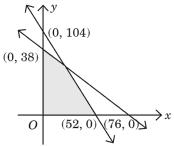
The feasible region of an LPP is given in the following figure
Image
Then, the constraints of the LPP are $x \geq 0, y \geq 0$ and