MCQ
If $A = \left[ {\begin{array}{*{20}{c}}\lambda &1\\{ - 1}&{ - \lambda }\end{array}} \right]$, then for what value of $\lambda ,\,{A^2} = O$
  • A
    $0$
  • $ \pm {\rm{ }}1$
  • C
    $-1$
  • D
    $1$

Answer

Correct option: B.
$ \pm {\rm{ }}1$
b
(b)  ${A^2} = A\,.\,A = \left[ {\begin{array}{*{20}{c}}\lambda &1\\{ - 1}&{ - \lambda }\end{array}} \right]\,\left[ {\begin{array}{*{20}{c}}\lambda &1\\{ - 1}&{ - \lambda }\end{array}} \right] = \left[ {\begin{array}{*{20}{c}}{{\lambda ^2} - 1}&0\\0&{ - 1 + {\lambda ^2}}\end{array}} \right] = 0$

(As given)

==> ${\lambda ^2} - 1 = 0 \Rightarrow \lambda = \pm 1$.

Need a full question paper?

Generate a complete, print-ready paper with questions like this in minutes — across 16+ boards, with answer keys.
Start Generating Free

Similar questions

If $m$ is the $A.M$ of two distinct real numbers $ l$  and $n (l,n>1) $ and  $G_1, G_2$ and $G_3$ are three geometric means between  $l$ and $n$ then $G_1^4 + 2G_2^4 + G_3^4$ equals :
If $p = 7i - 2j + 3k$ and $q = 3i + j + 5k,$ then the magnitude of $p - 2q$ is
$\mathop {\lim }\limits_{x \to {0^ + }} {\left( {\sec \sqrt x } \right)^{\frac{{10}}{x}}}$ is equal to
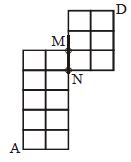
The number of shortest  paths from point $A\ to\ D$ (as shown in figure)
If all the words with or without meaning made using all the letters of the word $" \text{NAGPUR}"$ are arranged as in a dictionary, then the word at $315^{th}$ position in this arrangement is :
Three vertices are chosen randomly from the seven vertices of a regular $7$ -sided polygon. The probability that they form the vertices of an isosceles triangle is
Let $a_1, a_2 , a_3,.....$ be an $A.P$, such that $\frac{{{a_1} + {a_2} + .... + {a_p}}}{{{a_1} + {a_2} + {a_3} + ..... + {a_q}}} = \frac{{{p^3}}}{{{q^3}}};p \ne q$. Then $\frac{{{a_6}}}{{{a_{21}}}}$ is equal to
Let $\mathrm{ABC}$ be an equilateral triangle. A new triangle is formed by joining the middle points of all sides of the triangle $\mathrm{ABC}$ and the same process is repeated infinitely many times. If $\mathrm{P}$ is the sum of perimeters and $Q$ is be the sum of areas of all the triangles formed in this process, then:
Let $a, b, c$ and $d$ be non-zero numbers. If the point of intersection of the lines $4ax + 2ay + c = 0$ and $5bx + 2by + d =0$ lies in the fourth quadrant and is equidistant from the two axes then 
The sum of all the elements of the set $\{\alpha \in\{1,2, \ldots, 100\}: \operatorname{HCF}(\alpha, 24)=1\}$ is