MCQ
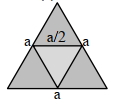
Let $\mathrm{ABC}$ be an equilateral triangle. A new triangle is formed by joining the middle points of all sides of the triangle $\mathrm{ABC}$ and the same process is repeated infinitely many times. If $\mathrm{P}$ is the sum of perimeters and $Q$ is be the sum of areas of all the triangles formed in this process, then:
  • $\mathrm{P}^2=36 \sqrt{3} \mathrm{Q}$
  • B
    $\mathrm{P}^2=6 \sqrt{3} \mathrm{Q}$
  • C
    $P=36 \sqrt{3} Q^2$
  • D
     $\mathrm{P}^2=72 \sqrt{3} \mathrm{Q}$

Answer

Correct option: A.
$\mathrm{P}^2=36 \sqrt{3} \mathrm{Q}$
a
Area of first $\Delta=\frac{\sqrt{3} \mathrm{a}^2}{4}$

Area of second $\Delta=\frac{\sqrt{3} a^2}{4} \frac{a^2}{4}=\frac{\sqrt{3} a^2}{16}$

Area of third $\Delta=\frac{\sqrt{3} \mathrm{a}^2}{64}$

sum of area $=\frac{\sqrt{3} a^2}{4}\left(1+\frac{1}{4}+\frac{1}{16} \ldots\right)$

$\mathrm{Q}=\frac{\sqrt{3} \mathrm{a}^2}{4} \frac{1}{\frac{3}{4}}=\frac{\mathrm{a}^2}{\sqrt{3}}$

perimeter of $1^{\text {st }} \Delta=3 \mathrm{a}$

perimeter of $2^{\text {nd }} \Delta=\frac{3 a}{2}$

perimeter of $3^{\text {rd }} \Delta=\frac{3 \mathrm{a}}{4}$

$ \mathrm{P}=3 \mathrm{a}\left(1+\frac{1}{2}+\frac{1}{4}+\ldots\right) $

$ \mathrm{P}=3 \mathrm{a} \cdot 2=6 \mathrm{a} $

$ \mathrm{a}=\frac{\mathrm{P}}{6} $

$ \mathrm{Q}=\frac{1}{\sqrt{3}} \cdot \frac{\mathrm{P}^2}{36} $

$ \mathrm{P}^2=36 \sqrt{3} \mathrm{Q}$

Need a full question paper?

Generate a complete, print-ready paper with questions like this in minutes — across 16+ boards, with answer keys.

Start Generating Free

Similar questions

$\int_{}^{} {\frac{{dx}}{{{x^2} + 2x + 2}} = } $
${n^{th}}$ term of the series $\frac{{{1^3}}}{1} + \frac{{{1^3} + {2^3}}}{{1 + 3}} + \frac{{{1^3} + {2^3} + {3^3}}}{{1 + 3 + 5}} + ......$ will be
Suppose the sequence $a_1, a_2, a_3, \ldots$ is a n arithmetic progression of distinct numbers such that the sequence $a_1, a_2, a_4, a_8, \ldots$ is a geometric progression. The common ratio of the geometric progression is
$\tan \,{20^o}\cot \,{10^o}\cot \,{50^o}$ is equal to
An are $P Q$ of a circle subtends a right angle at its centre $O$. The mid point of the arc $P Q$ is $R$. If $\overline{O P}=\vec{u}, \overline{O R}=\vec{v}$ and $\overrightarrow{O Q}=\alpha \vec{u}+\beta \vec{v}$, then $\alpha, \beta^2$ are the roots of the equation
If $\mathop {\lim }\limits_{x \to \infty } {\left( {1 + \frac{a}{x} - \frac{4}{{{x^2}}}} \right)^{2x}} = {e^3},$ then $'a'$ is equal to
If ${\tan ^{ - 1}}\frac{{x - 1}}{{x + 1}} + {\tan ^{ - 1}}\frac{{2x - 1}}{{2x + 1}} = {\tan ^{ - 1}}\frac{{23}}{{36}},$ then $ x =$
Divide  $20$  into two parts such that the product of one part and the cube of the other is maximum. The two parts are
The equation of the locus of a point which moves so as to be at equal distances from the point $(a, 0)$ and the $y$ - axis is
A and B alternately throw a pair of dice. A wins if he throws a sum of 5 before $B$ throws a sum of 8 , and B wins if he throws a sum of 8 before A throws a sum of 5 . The probability, that $A$ wins if A makes the first throw, is