Question
If $A =\left[\begin{array}{cc}1 & 2 \\ -2 & 3\end{array}\right], B =\left[\begin{array}{ll}2 & 1 \\ 2 & 3\end{array}\right] C =\left[\begin{array}{cc}-3 & 1 \\ 2 & 0\end{array}\right]$ verify that $(AB)C = A(BC),$

Answer

$A B=\left[\begin{array}{cc}1 & 2 \\ -2 & 3\end{array}\right]\left[\begin{array}{ll}2 & 1 \\ 2 & 3\end{array}\right] $
$ =\left[\begin{array}{cc}2+4 & 1+6 \\ -4+6 & -2+9\end{array}\right]=\left[\begin{array}{ll}6 & 7 \\ 2 & 7\end{array}\right]$
$( AB ) C =\left[\begin{array}{ll}6 & 7 \\ 2 & 7\end{array}\right]\left[\begin{array}{cc}-3 & 1 \\ 2 & 0\end{array}\right] $
$=\left[\begin{array}{cc}-18+14 & 6+0 \\ -6+14 & 2+0\end{array}\right]=\left[\begin{array}{cc}-4 & 6 \\ 8 & 2\end{array}\right] $
Now $,  BC =\left[\begin{array}{ll}2 & 1 \\ 2 & 3\end{array}\right]\left[\begin{array}{cc}-3 & 1 \\ 2 & 0\end{array}\right] $
$ =\left[\begin{array}{cc}-6+2 & 2+0 \\ -6+6 & 2+0\end{array}\right]=\left[\begin{array}{cc}-4 & 2 \\ 0 & 2\end{array}\right]$
$ A(B C)=\left[\begin{array}{cc} 1 & 2 \\ -2 & 3 \end{array}\right]\left[\begin{array}{cc} -4 & 2 \\
0 & 2 \end{array}\right] $
$=\left[\begin{array}{cc} -4+0 & 2+4 \\ 8+0 & -4+6  \end{array}\right]=\left[\begin{array}{cc} -4 & 6 \\ 8 & 2
\end{array}\right]$
Hence, $(A B) C=A(B C)$.

Need a full question paper?

Generate a complete, print-ready paper with questions like this in minutes — across 16+ boards, with answer keys.
Start Generating Free

Similar questions

Solve the following equation by using formula :
$10ax^2 – 6x + 15ax – 9 = 0,a\neq 0$
Find the ratio in which the line $y = -1$ divides the line segment joining $(6, 5)$ and $(-2, -11).$ Find the coordinates of the point of intersection.
If $x =\frac{\sqrt{a+x}+\sqrt{a-1}}{\sqrt{a+1-\sqrt{a-1}}}$, using properties of proportion, show that $x^2-2 a x+1=0$
Following is the data of maximum temperatures recorded in 20 days in a city:
$\begin{aligned}& 10^{\circ} \mathrm{C}, 12^{\circ} \mathrm{C}, 15^{\circ} \mathrm{C}, 40^{\circ} \mathrm{C}, 25^{\circ} \mathrm{C}, 20^{\circ} \mathrm{C}, 30^{\circ} \mathrm{C}, 28^{\circ} \mathrm{C}, 25^{\circ} \mathrm{C}, 27^{\circ} \mathrm{C}, 18^{\circ} \mathrm{C}, 32^{\circ} \mathrm{C}, 34^{\circ} \mathrm{C}, 27^{\circ} \mathrm{C}, 29^{\circ} \mathrm{C}, 16^{\circ} \mathrm{C}, 37^{\circ} \mathrm{C}, 35^{\circ} \mathrm{C}, \\& 33^{\circ} \mathrm{C}, 22^{\circ} \mathrm{C} .\end{aligned}$
Prepare the frequency table and draw a histogram to represent the above data.
Solve the following quadratic equation using formula method only
$\frac{5}{4} x^2-2 \sqrt{5} x+4=0$
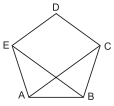
Prove that any four vertices of a regular pentagon are concyclic.
Image
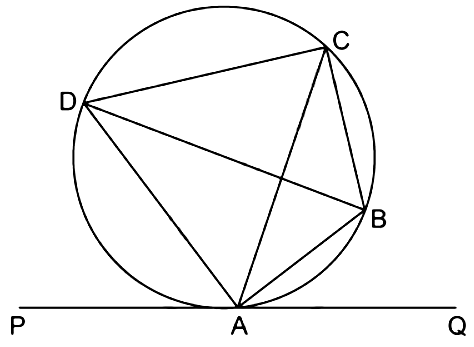
In the given figure, PQ is a tangent to the circle at A. AB and AD are bisectors of ∠CAQ and ∠PAC. If ∠BAQ = 30°, prove that : BD is diameter of the circle.
Find three numbers in A.P whose sum is $24$ and whoseproduct is $440$
Find the value of $'a\ ’$ for which the following points $A (a, 3), B (2, 1)$ and $C (5, a)$ are collinear. Hence find the equation of the line.
Two chords AB and CD intersect at P inside the circle. Prove that the sum of the angles
subtended by the arcs AC and BD at the centre O is equal to twice the angle APC.