MCQ
If a pair of linear equations in two variables is consistent, then the lines represented by two equations are:
  • A
    Intersecting.
  • B
    Parallel.
  • C
    Always coincident.
  • Intersecting or coincident.

Answer

Correct option: D.
Intersecting or coincident.
If a pair of linear equations in two variables is consistent, then its solution exists.
$\therefore$ The lines represented by the equations are either intersecting or coincident.
Hence, correct choice is d.

Need a full question paper?

Generate a complete, print-ready paper with questions like this in minutes — across 16+ boards, with answer keys.

Start Generating Free

Similar questions

How many tangents can be drawn to a circle from a point on it?
A right circular cylinder of radius $r$ and height $h \ (h = 2r)$ just encloses a sphere of diameter :
The calculation for mode for the following distribution is given below:
Here, the maximum frequency is 32 and the corresponding modal class is $30-40$.
$\therefore \quad l=30, h=10, f_0=12, f_1=32, f_2=20($ Step 1$)$
$\therefore \quad$ Mode $=l+\left(\frac{f_1-f_0}{2 f_1-f_0-f_2}\right) \times h \quad$ (Step 2)
$=30+\left(\frac{32-12}{64-12-20}\right) \times 10=30+\frac{25}{4}=36.25$ (Step 3$)$
In which step is there an error in solving?
MarksNumber of students
0-106
10-2010
20-3012
30-4032
40-5020
A solid consists of a circular cylinder surmounted by a right circular cone. The height of the cone is h. If the total height of the solid is 3 times the volume of the cone, then the height of the cylinder is:
The graph of a cubic polynomial $x^3-4 x$ meets the $x-$ axis at $(-2, 0), (0, 0) $ and $(2, 0),$ then the zeroes of the polynomial are :
If $2 \cos \theta=1$, then the value of $\theta$ is
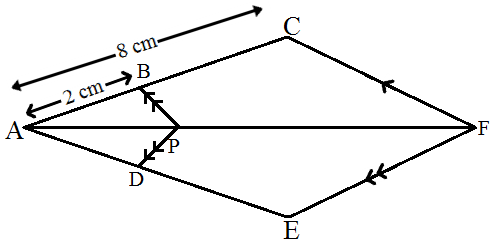
In the figure, if PB || CF and DP || EF, then $\frac{\text{AD}}{\text{DE}}=$
Choose the correct answer from the given four options : The lengths of the diagonals of a rhombus are $16\ cm$ and $12\ cm$. Then, the length of the side of the rhombus is :
If the arithmetic mean of first n natural numbers is 15, then n is equal to
The mean of n observations is $\bar{\text{x}}$ If the first observation is increased by 1, the second by 2, the third by 3, and so on, then the new mean is: