MCQ
If a particle is moving on a circular path with constant speed, then the angle between the direction of acceleration and its position vector w.r.t. centre of circle will be ............ 
  • $\pi$
  • B
    $\frac{\pi}{2}$
  • C
    Zero
  • D
    $2 \pi$

Answer

Correct option: A.
$\pi$
a
(a)

Direction of Velocity is tangential to the circular path at any instance. At the very same instance, acceleration is along the radius, directed towards centre. So the angle between the direction of acceleration and its position vector with respect to the centre of the circle will be $\pi$ or $180^{\circ}$.

Need a full question paper?

Generate a complete, print-ready paper with questions like this in minutes — across 16+ boards, with answer keys.
Start Generating Free

Similar questions

A stone of mass $m$ is tied to a string of length $l$ and rotated in a circle with a constant speed $v$. If the string is released, the stone flies
Two cars $A$ and $B$ are moving with same speed of $45\,km/h$ along same direction. If a third car $C$ coming from the opposite direction with a speed of $36\,km/h$ meets two cars in an interval of $5\,min,$ the distance of separation of two cars $A$ and $B$ should be.......$km$
The displacement of a particle varies with time as $x = 12\sin \omega t - 16{\sin ^3}\omega t$ (in $cm$). If its motion is $S.H.M.$, then its maximum acceleration is
A body is thrown vertically up from the ground. It reaches a maximum height of $100\,m$ in $5\,sec$. After what time it will reach the ground from the maximum height position..........$sec$
Acylindrical vessel open at the top is $20$ $cm$ high and $10$ $cm$ in diameter.Acircular hole whose cross-sectional area $1$ $cm^2$ is cut at the centre of the bottom of the vessel. Water flows from a tube above it into the vessel at the rate $100$ $cm^3s^{^{-1}}$. The height of water in the vessel under steady state is ....... $cm$ (Take $g=1000 $ $ cms^{^{-2}})$
What is the number of significant figures in $3400$
The kinematic equations of rectilinear motion for constant acceleration for a general situation, where the position coordinate at t = 0 is non-zero, say x0 is:
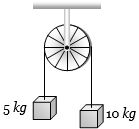
Two masses as shown are suspended from a massless pulley. Calculate the acceleration of the system when masses are left free
Nature of meniscus for liquid of ${0^o}$ angle of contact
A pendulum suspended from the ceiling of a train has a period $T$ when the train is at rest. When the train travels same distance per unit time, the period of oscillation is