MCQ
If a particle moves from point $P (2,3,5)$ to point $Q (3,4,5)$. Its displacement vector be
  • A
    $\hat i + \hat j + 10\hat k$
  • B
    $\hat i + \hat j + 5\hat k$
  • $\hat i + \hat j$
  • D
    $2\hat i + 4\hat j + 6\hat k$

Answer

Correct option: C.
$\hat i + \hat j$
c
(c) Displacement vector $\overrightarrow {r\,} = \Delta x\hat i + \Delta y\hat j + \Delta z\hat k$

$ = (3 - 2)\hat i + (4 - 3)\hat j + (5 - 5)\hat k$$ = \hat i + \hat j$

Need a full question paper?

Generate a complete, print-ready paper with questions like this in minutes — across 16+ boards, with answer keys.
Start Generating Free

Similar questions

The dimensional formula for $r.m.s.$ (root mean square) velocity is
In order to double the frequency of the fundamental note emitted by a stretched string, the length is reduced to $\frac{3}{4}$$^{th}$ of the original length and the tension is changed. The factor by which the tension is to be changed, is
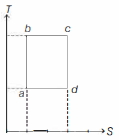
An ideal gas is taken reversibly around the cycle $a-b-c-d-a$ as shown on the temperature $T$ - entropy $S$ diagram. The most appropriate representation of above cycle on a internal energy $U$ - volume $V$ diagram is
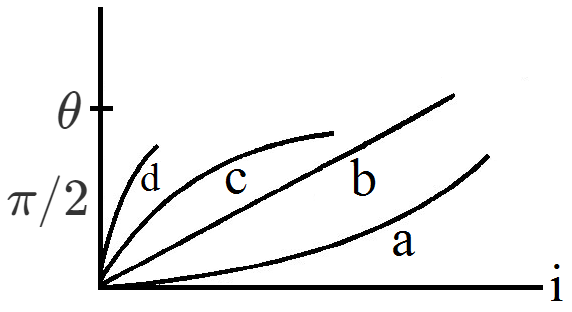
Which of the following four graphs may best represent the current$-$deflection relation in a tangent galvanometer?
The kinetic energy of one mole gas at $300K$ temperature, is $E.$ At $400K$ temperature kinetic energy is $E'.$ The value of $E'/E$ is
A block of mass $5\,kg$ starting from rest pulled up on a smooth incline plane making an angle of $30^{\circ}$ with horizontal with an affective acceleration of $1\,ms ^{-2}$. The power delivered by the pulling force at $t =10\,s$ from the start is $.....\,W.$ $\left[\right.$ Use $\left.g =10\,ms ^{-2}\right]$ (calculate the nearest integer value)


A particle falls towards earth from infinity. Its velocity on reaching the earth would be:
A capillary tube of radius $0.2\,cm$ is dipped vertically in a beaker containing liquid. If the liquid rises to a height of $5\,cm$ for which the angle of contact is $60^o$ , then surface tension of the liquid is ...... $dynes/cm$ $(d = 1\,gm/cm^3)$
A particle executes simple harmonic motion represented by displacement function as $x(t)=A \sin (\omega t+\phi)$

If the position and velocity of the particle at $t=0\, {s}$ are $2\, {cm}$ and $2\, \omega \,{cm} \,{s}^{-1}$ respectively, then its amplitude is $x \sqrt{2} \,{cm}$ where the value of $x$ is ..... .

A $3\ kg$ sphere dropped through air has a terminal speed of $25\ m/s$. (Assume that the drag force is $-bv$.) Now suppose the sphere is attached to a spring of force constant $k = 300\ N/m$, and that it oscillates with an initial amplitude of $20\ cm$. What is the angular frequencu of its damped $SHM$? ..... $rad/s$