MCQ
The dimensional formula for $r.m.s.$ (root mean square) velocity is
  • ${M^0}L{T^{ - 1}}$
  • B
    ${M^0}{L^0}{T^{ - 2}}$
  • C
    ${M^0}{L^0}{T^{ - 1}}$
  • D
    $ML{T^{ - 3}}$

Answer

Correct option: A.
${M^0}L{T^{ - 1}}$
a
The dimensional formula for the $RMS$ velocity is same as the normal velocity.

So, dimension of $RMS$ velocity is $=\left[ M ^0 LT ^{-1}\right]$

Need a full question paper?

Generate a complete, print-ready paper with questions like this in minutes — across 16+ boards, with answer keys.
Start Generating Free

Similar questions

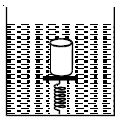
A cylindrical block of area of cross-section $A$ and of material of density $\rho$ is placed in a liquid of density one-third of density of block. The block compresses a spring and compression in the spring is one-third of the length of the block. If acceleration due to gravity is $g$, the spring constant of the spring is:
The value of $‘g’$ at a particular point is $9.8\,m/{s^2}$. Suppose the earth suddenly shrinks uniformly to half its present size without losing any mass. The value of $‘g’$ at the same point (assuming that the distance of the point from the centre of earth does not shrink) will now be ......... $m/{\sec ^2}$.
The system shown in figure is released then $a_1$ and $a_2$ is
The gravitational force between two stones of mass $1\, kg $ each separated by a distance of $1 \,metre$ in vacuum is
The motion of a particle executing $S.H.M.$ is given by $x = 0.01\sin 100\pi (t + .05)$, where $x$ is in metres and time is in seconds. The time period is ..... $\sec$
The expansion coefficients a, ẞ and y of a solid are related to its volume :
The acceleration vector of a particle in uniform circular motion averaged over the cycle is a null vector. This statement is
What is the path followed by a moving body, on which a constant force acts in a direction other than initial velocity (i.e. excluding parallel and antiparallel direction)?
A metallic rod of cross-sectional area $9.0\,\,cm^2$ and length $0.54 \,\,m$, with the surface insulated to prevent heat loss, has one end immersed in boiling water and the other in ice-water mixture. The heat conducted through the rod melts the ice at the rate of $1 \,\,gm$ for every $33 \,\,sec$. The thermal conductivity of the rod is ....... $ Wm^{-1} K^{-1}$
A parrot sitting on the floor of a wire cage which is being carried by a boy starts flying. The boy will feel that the box is now: