MCQ
If a particle moves in a circle describing equal angles in equal times, its velocity vector
  • A
    Remains constant
  • B
    Changes in magnitude
  • Changes in direction
  • D
    Changes both in magnitude and direction

Answer

Correct option: C.
Changes in direction
c
(c)It is always directed in a direction of tangent to circle.

Need a full question paper?

Generate a complete, print-ready paper with questions like this in minutes — across 16+ boards, with answer keys.
Start Generating Free

Similar questions

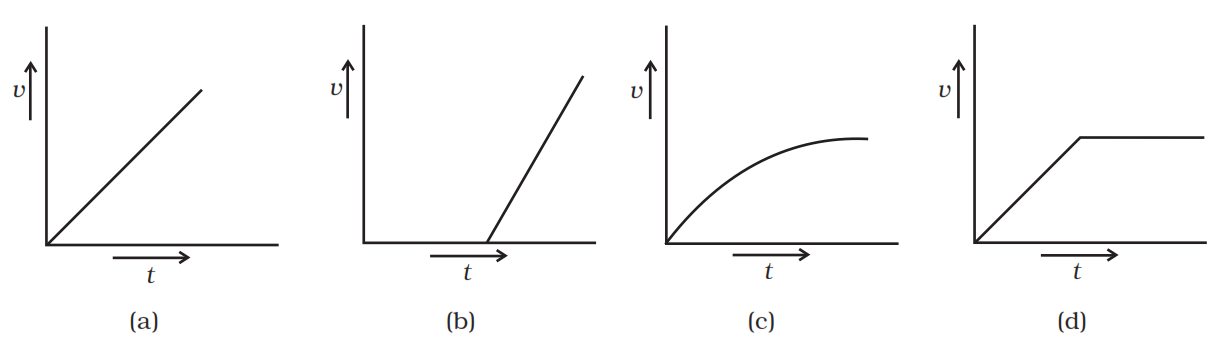
A tall cylinder is filled with viscous oil. A round pebble is dropped from the top with zero initial velocity. From the plot shown in indicate the one that represents the velocity (v) of the pebble as a function of time (t):

A uniform rope having some mass hanges vertically from a rigid support. A transverse wave pulse is produced at the lower end. The speed $(v)$ of the wave pulse varies with height $(h)$ from the lower end as:
Let $\overrightarrow C = \overrightarrow A + \overrightarrow B $ then
In $5\, minutes,$ a body cools from $75^{\circ} {C}$ to $65^{\circ} {C}$ at room temperature of $25^{\circ} {C}$. The temperature of body at the end of next $5\, minutes$ is $......\,{ }^{\circ} {C} .$
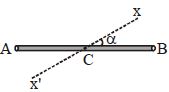
The moment of inertia of a uniform rod of length $2l$ and mass $m$ about an axis $xx'$ passing through its centre and inclined at an angle $\alpha $ is 
A physical balance has its arms of unequal length. A body weighs $18 \,kg$ if kept in one pan and weighs $8 \,kg$ if kept in the other pan. The true weight of the body is ............. $kg$
Coatings used on raincoat are waterproof because
The dimensions of Stefan-Boltzmann's constant $\sigma$ can be written in terms of Planck's constant $h$, Boltzmann's constant $k_B$ and the speed of light $c$ as $\sigma=h^\alpha k_B^\beta c^\gamma$. Here,
Applying the principle of homogeneity of dimensions, determine which one is correct. where $\mathrm{T}$ is time period, $\mathrm{G}$ is gravitational constant, $M$ is mass, $r$ is radius of orbit.
When a horse pulls a cart, the force that helps the horse to move forward is the force exerted by:
  1. The cart on the horse.
  2. The ground on the horse.
  3. The ground on the cart.
  4. The horse on the ground.