MCQ
If a particle moves in a circle describing equal angles in equal times, its velocity vector
  • A
    Remains constant
  • B
    Changes in magnitude
  • Changes in direction
  • D
    Changes both in magnitude and direction

Answer

Correct option: C.
Changes in direction
c
(c)It is always directed in a direction of tangent to circle.

Need a full question paper?

Generate a complete, print-ready paper with questions like this in minutes — across 16+ boards, with answer keys.

Start Generating Free

Similar questions

For a gas with one degree of freedom the adiabatic yield is $\gamma=\frac{ C _{ p }}{ C _{ v }}$
The masses and radii of the earth and moon are ${M_1},\,{R_1}$ and ${M_2},\,{R_2}$ respectively. Their centres are distance d apart. The minimum velocity with which a particle of mass $m$ should be projected from a point midway between their centres so that it escapes to infinity is
A particle of mass $m$ moves in a circular orbit under the central potential field, $U ( r )=\frac{- C }{ r }$, where $C$ is a positive constant

The correct radius - velocity graph of the particle's motion is:
The height at which the acceleration due to gravity becomes $\frac{g}{9}$ (where $g$ = the acceleration due to gravity on the surface of the earth) in terms of $R$, the radius of the earth, is
If the current is doubled, the deflection is also doubled in:
  1. A tangent galvanometer.
  2. A moving-coil galvanometer.
  3. Both.
  4. None.
An inductor, a resistance and a capacitor are joined in series with an AC source. As the frequency of the source is slightly increased from a very low value, the reactance:
  1. Of the inductor increases.
  2. Of the resistor increases.
  3. Of the capacitor increases.
  4. Of the circuit increases.
If the displacement equation of a particle be represented by $y = A\sin PT + B\cos PT$, the particle executes
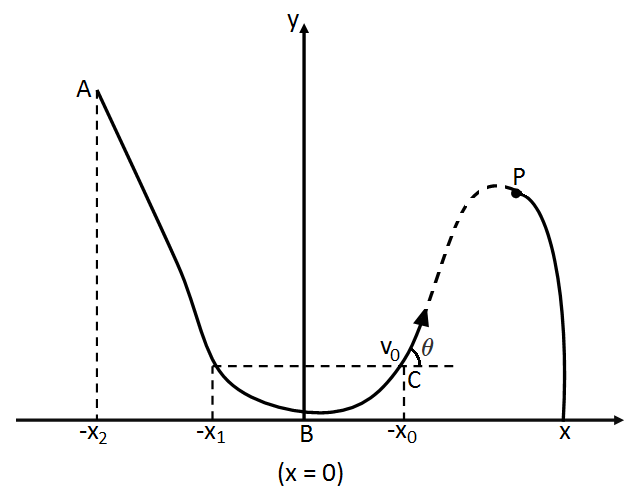
A particle slides down a frictionless parabolic (y = x) track (A – B – C) starting from rest at point A. Point B is at the vertex of parabola and point C is at a height less than that of point A. After C, the particle moves freely in air as a projectile. If the particle reaches highest point at P, then

  1. KE at P = KE at B.
  2. height at P = height at A.
  3. total energy at P = total energy at A.
  4. time of travel from A to B = time of travel from B to P.
The diameters of two planets are in ratio $4:1$ . Their mean densities have ratio $1:2$ . The ratio of gravitational acceleration on the surface of planets will be
What must be the lengths of steel and copper rods at $0^o C$ for the difference in their lengths to be $10\,cm$ at any common temperature? $(\alpha_{steel}=1.2 \times {10^{-5}} \;^o C^{-1})$ and $(\alpha_{copper} = 1.8 \times 10^{-5} \;^o C^{-1})$