Question
If a person throw a ball up and catches it again after 8 sec . then tell :
(a) With what velocity was the ball thrown up?
(b) At what height will the velocity of the ball be zero?
Answer

(a) It takes equal time for a ball to go up and come down.
$\therefore$ Time to go up only $=\frac{8}{2}=4 sec$.
For vertical upward,
$\begin{array}{ll}
v=u-gt & t=4(s) \\
0=u-9.8 \times 4 & u=?, v=0 m / s \\
u=39.2 m / s & g=9.8 m / s^2
\end{array}$
(b) Assume that the velocity at height h will be zero
$\begin{aligned}
v^2 & =u^2-2 gh \\
0 & =39.2 \times 39.2-2 \times 9.8 \times h \\
h & =\frac{39.2 \times 39.2}{2 \times 9.8}=78.4 \text { meter }
\end{aligned}$

Need a full question paper?

Generate a complete, print-ready paper with questions like this in minutes — across 16+ boards, with answer keys.

Start Generating Free

Similar questions

Write the formula for the speed of transverse waves in a stretched string and explain the symbols used in it
What is the Young’s modulus for a perfect rigid body?
The time period of a simple pendulum is 4 seconds and its effective length is 4 meters. By what length given that should it make 15 oscillations in 30 seconds?
The velocity of a particle is given by equation $v=4+2\left(c_1+c_2 t\right)$, where $c_1$ and $c_2$ care constant. Find the initial velocity and acceleration of the particle.
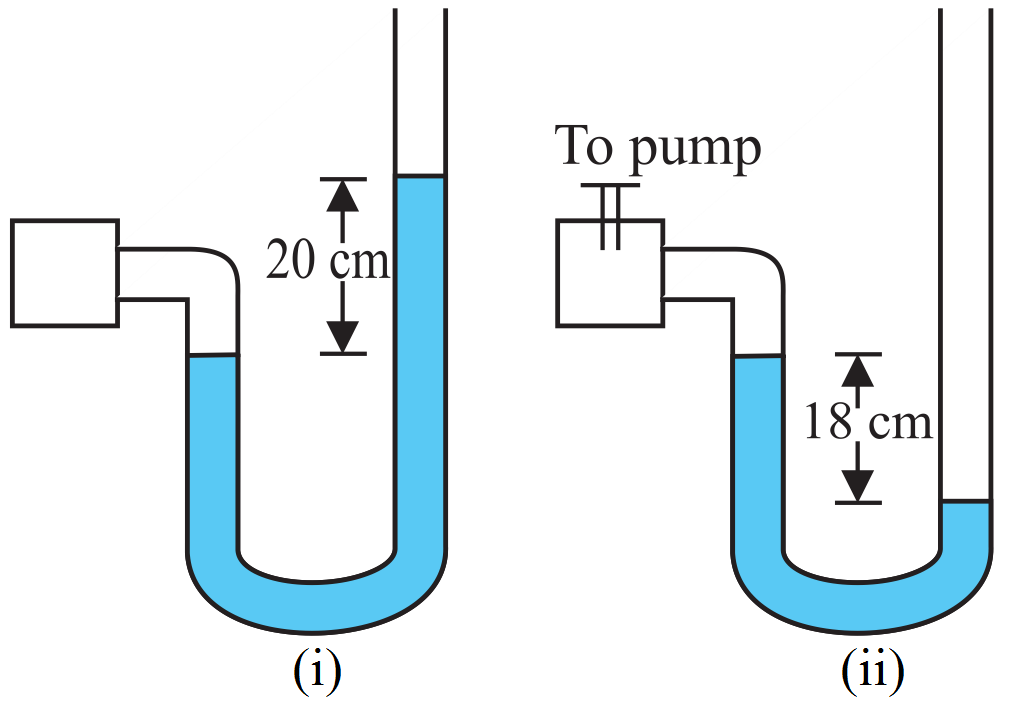
A manometer reads the pressure of a gas in an enclosure as shown in Fig.(a) When a pump removes some of the gas, the manometer reads as in Fig. (b) The liquid used in the manometers is mercury and the atmospheric pressure is $76cm$ of mercury. Give the absolute and gauge pressure of the gas in the enclosure for cases (i) and (ii) in units of cm of mercury. How would the levels change in case (i) if $13.6cm$ of water (immiscible with mercury) are poured into the right limb of the manometer? (Ignore the small change in volume of the gas.)
The angle made by the string of a simple pendulum with the vertical depends on time as $\theta=\frac{\pi}{90}\sin[(\pi\text{s}^{-1})\text{t}].$ Find the length of the pendulum if $\text{g}=\pi^2\text{m/s}^2.$
Given below are some functions of x and t to represent the displacement of an elastic wave.$​​​​\text{y}=10\cos[(252-250)\pi\text{t}]\cos[(252+250)\pi\text{t}]$
Calculate the dimensions of force and impulse taking velocity, density and frequency as basic quantities.
What should be the average velocity of water in a tube of radius 0.005m so that the flow is just turbulent? The viscosity of water is 0.001Pas.
The torque of a force $\overrightarrow{\text{F}}$ about a point is defined as $\overrightarrow{\text{r}}=\overrightarrow{\text{r}}\times\overrightarrow{\text{F}}.$ Suppose $\overrightarrow{\text{r}}, \overrightarrow{\text{F}}$and $\overrightarrow{\text{r}}$ are all nonzero. Is $\text{r}\times\overrightarrow{\text{r}}\Bigg|\Bigg|\overrightarrow{\text{F}}$ always true? Is it ever true?