Question types

PART - 1 CH - 2 Motion in a Straight Line question types

104 questions across 8 question groups — pick any mix to generate a Physics paper with step-by-step answer keys.

104
Questions
8
Question groups
5
Question types
Sample Questions

PART - 1 CH - 2 Motion in a Straight Line questions

One sample from each question group in this chapter. Select any group above to see the full set with answer keys.

If the distance covered by an object is directly proportional to time, then we can say that the object :
  • A
    moves with zero velocity
  • B
    moving at a constant speed
  • C
    acceleration is constant
  • has the same velocity

Answer: D.

View full solution
When an object covers equal distances in equal time intervals, then its speed is:
  • A
    slow motion
  • B
    accelerated pace
  • C
    uneven motion
  • uneven motion

Answer: D.

View full solution
When a body thrown vertically upward from the earth's surface is at its maximum height, then its :
  • A
    velocity is maximum
  • B
    acceleration is zero
  • C
    acceleration is maximum
  • velocity is zero

Answer: D.

View full solution
A piece of stone is thrown into the air. Acceleration of stone :
  • A
    will always be upwards
  • will always be downwards
  • C
    It will be upwards in upward journey and downwards in downward journey.
  • D
    It will be downwards in upward journey and upwards in downward journey.

Answer: B.

View full solution
If the displacement of an object is directly proportional to the square of time, then the speed of the object is :
  • with uniform acceleration
  • B
    due to unequal acceleration
  • C
    at uniform speed
  • D
    unequal acceleration but uniform speed

Answer: A.

View full solution
A ball thrown vertically upwards from the earth's surface. After reaching a height, it returns to the earth after some time, then its distance will be ................ and displacement will be ................ .
View full solution
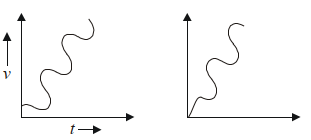
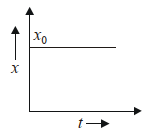
Two objects are given, whose initial conditions are different but the relative velocities is zero. Draw the position time diagram for the corners.
View full solution
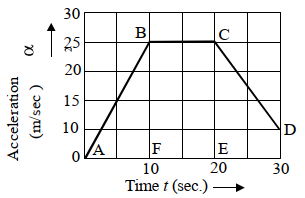
In the given figure the time-acceleration graph of an object moving in a straight line is given. Determined from graph :(i) Average acceleration in the first 20 sec.(ii) From what time tell what time the force acts on the object?Image
View full solution
The particle position in one-dimensional motion is
$
x=\left(3+4 t-t^2\right) \text { meter }
$
Draw the displacement velocity diagram for this motion from the time interval $t=0 sec$ to $t=4 sec$.
View full solution
If a person throw a ball up and catches it again after 8 sec . then tell :
(a) With what velocity was the ball thrown up?
(b) At what height will the velocity of the ball be zero?
View full solution
If the initial velocity of a particle is $u$ and the acceleration in the same direction changes with time as $\alpha t$, then what will be the velocity at time $t$ ?
View full solution
The displacement of an object changes with time according to $s=t^3-6 t^2+3 t+4$, then the acceleration of the object at instant is zero. What is its velocity?
View full solution
Q 233 Marks Question3 Marks
In one-dimensional motion the velocity of a particle depends on time in the following manner :
$
v=(5 t+7) m / s
$
If the particle is at the origin at $t=0$, then what will be the position of the particle at $t=2 sec$ ?
View full solution
Q 243 Marks Question3 Marks
An object falling freely from above is in the last second its total height crosses the division of 16 / 25 then find :
(i) Total height, (ii) Time of fall.
View full solution
Q 253 Marks Question3 Marks
A train start moving from rest and its speed increases with uniform acceleration for 10 sec . At the end of 5 sec . its speed become $54 km /$ hour.
(a) Find the acceleration of the train.
(b) What will be its speed after 10 sec ?
(c) How much distance will the train travel in 10 sec?
(d) How much distance did the train cover in the seventh and tenth second respectively?
View full solution
Position $x$, time of particle moving in onedimensional motion depends on as follows :
$x=5+5 t-t^2$
(All quantities are in SI units) For this motion draw (i) displacement-time (ii) Velocity-time (iii) Acceleration-time graphs for the time interval $t=0 sec$ to $t=6 sec$ and describe the motion.
View full solution
Define velocity and acceleration. Draw a velocity time graph for uniformly accelerated motion and prove that the area between the curve of this graph and the time axis is equal to the displacement of the moving object
View full solution
(I)(II)
1. Acceleration a = dv/dt =(A) $1: 3$
2. How to find the acceleration of a moving object?(B) In one-dimensional motion when the direction of the body does not change
3. If the mutual graph of two quantities is a straight line, then both the quantities are:(C) By the slope of veloc- ity-time graph
4. The ratio of the distances covered by a freely falling object in its first and second second is(D) Directly Proportional
5. In which position of the body, the value of displacement is equal to the distance travelled by the body?(E)$\tan \theta$
View full solution
(I)(II)
1. For a circular path, if an object moves from A and comes back to A, what will be the value of displacement?(A) displacement
2. When a body moves in a straight line with a constant velocity in the same direction, then what will be the value of acceleration of the body?(B) $\tan \theta$
3. In case of unequal velocity, the displacement and time diagram will have to be made in addition to the straight line.(C) Zero
4. In the velocity-time graph, the area between the curve and the time axis is equal to which quantity of the body?(D) Zero
5 Acceleration a = dv/dt =(E) of any shape
View full solution

Generate a PART - 1 CH - 2 Motion in a Straight Line paper free

Pick question groups from the list above, set marks and difficulty, and export a branded PDF with step-by-step answer keys. First 3 chapters free — no signup.

Download App