Question
If a proton, deutron and $\alpha - $ particle on being accelerated by the same potential difference enters perpendicular to the magnetic field, then the ratio of their kinetic energies is

Answer

(d) Kinetic energy in magnetic field remains constant and it is $K = q\,V\;\; \Rightarrow \;K \propto q\;$($V$ = constant)
$\therefore \;{K_p}\;:\;{K_d}\;:\;{K_\alpha }\; = {q_p}\;:\;{q_d}\;:\;{q_a} = 1:1:2$

Need a full question paper?

Generate a complete, print-ready paper with questions like this in minutes — across 16+ boards, with answer keys.
Start Generating Free

Similar questions

The ratio of two specific heats of gas ${C_p}/{C_v}$ for argon is $1.6$ and for hydrogen is $1.4$. Adiabatic elasticity of argon at pressure $P$ is $E.$ Adiabatic elasticity of hydrogen will also be equal to $E$ at the pressure
A $100 \,g$ mass stretches a particular spring by $9.8 \,cm$, when suspended vertically from it. ....... $g$ large a mass must be attached to the spring if the period of vibration is to be $6.28 \,s$.
A projectile has the same range $R$ for two angles of projection. If $T_1$ and $T_2$ be the times of flight in the two cases, then $R$ is
Three vectors $\overrightarrow a ,\,\overrightarrow b $and $\overrightarrow c $ satisfy the relation $\overrightarrow a \,.\,\overrightarrow b = 0$ and $\overrightarrow a \,.\,\overrightarrow c = 0.$ The vector $\overrightarrow a $ is parallel to
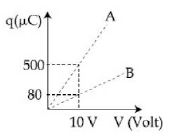
Figure shows charge $(q)$ versus voltage $(V)$ graph for series and parallel combination of to given capacitors. The capacitances are
A thin flat circular disc of radius $4.5 \mathrm{~cm}$ is placed gently over the surface of water. If surface tension of water is $0.07 \mathrm{~N} \mathrm{~m}^{-1}$, then the excess force required to take it away from the surface is
Half lives for $\alpha$ and $\beta$ emission of a radioactive material are $16$ years and $48$ years respectively. When material decays giving $\alpha$ and $\beta$ emission simultaneously then time in which $\frac{3}{4}$ th of the material decays is ....... years
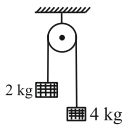
Two blocks of mass $2 \mathrm{~kg}$ and $4 \mathrm{~kg}$ are connected by a metal wire going over a smooth pulley as shown in figure. The radius of wire is $4.0 \times 10^{-5}$ $\mathrm{m}$ and Young's modulus of the metal is $2.0 \times 10^{11} \mathrm{~N} / \mathrm{m}^2$. The longitudinal strain developed in the wire is $\frac{1}{\alpha \pi}$. The value of $\alpha$ is [Use $\mathrm{g}=10 \mathrm{~m} / \mathrm{s}^2$ )
For a gas at a temperature $T$ the root-mean-square velocity ${v_{rms}},$ the most probable speed ${v_{mp}},$ and the average speed ${v_{av}}$ obey the relationship
A  radiation of energy $'E'$ falls normally on a perfectly reflecting surface. The momentum transferred to the surface is $( C =$ Velocity of light $)$