MCQ
Three vectors $\overrightarrow a ,\,\overrightarrow b $and $\overrightarrow c $ satisfy the relation $\overrightarrow a \,.\,\overrightarrow b = 0$ and $\overrightarrow a \,.\,\overrightarrow c = 0.$ The vector $\overrightarrow a $ is parallel to
  • A
    $\overrightarrow b $
  • B
    $\overrightarrow c $
  • C
    $\overrightarrow b \,.\,\overrightarrow c $
  • $\overrightarrow b \times \overrightarrow c $
Answer

Correct option: D.
$\overrightarrow b \times \overrightarrow c $
d
(d ) $\vec a\,.\,\vec b = 0$ i.e. $\vec a $ and $\vec b$ will be perpendicular to each other

$\vec a\,.\,\vec c = 0$ i.e. $\vec a$ and $\vec c$ will be perpendicular to each other

$\vec b \times \vec c$ will be a vector perpendicular to both $\vec b$ and $\vec c$

So $\vec a$ is parallel to $\vec b \times \vec c$

Need a full question paper?

Generate a complete, print-ready paper with questions like this in minutes — across 16+ boards, with answer keys.

Start Generating Free

Similar questions

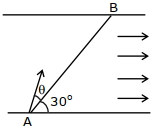
A swimmer wants to cross a river from point $A$ to point $B$. Line $A B$ makes an angle of $30^{\circ}$ with the flow of river. Magnitude of velocity of the swimmer is same as that of the river. The angle $\theta$ with the line ${AB}$ should be $^{\circ}$, so that the swimmer reaches point ${B}$.
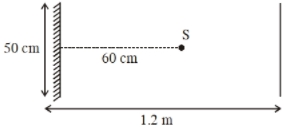
A point source of light $S$, placed at a distance $60 \,cm$ infront of the centre of a plane mirror of width $50 \,cm$, hangs vertically on a wall. A man walks infront of the mirror along a line parallel to the mirror at a distance $1.2\, m$ from it (see in the $figure$). The distance between the extreme points where he can see the image of the light source in the mirror is $\ldots \ldots \ldots\, cm.$
The angular amplitude of a simple pendulum is $\theta_0$. The maximum tension in its string will be
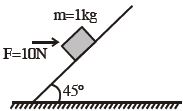
A body of mass $1\, kg$ lies on smooth inclined plane. The body is given force $F = 10N$  horizontally as shown. The magnitude of net normal reaction on the body is 
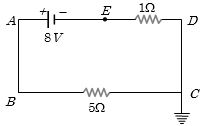
In the given circuit, the potential of the point $E$ is
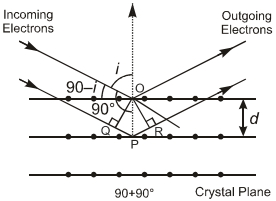
Wave property of electrons implies that they will show diffraction effects. Davisson and Germer demonstrated this by diffracting electrons from crystals. The law governing the diffraction from a crystal is obtained by requiring that electron waves reflected from the planes of atoms in a crystal interfere constructively (see figure).
A swimmer can swim with velocity of $12 \,km / h$ in still water. Water flowing in a river has velocity $6\, km / h$. The direction with respect to the direction of flow of river water he should swim in order to reach the point on the other bank just opposite to his starting point is ........$^{\circ}$. (Round off to the Nearest Integer) (find the angle in degree)
A car moves along a circular track of radius $R$ banked at an angle of $30^o$ to the horizontal. The coefficient of static friction between the wheels and the track is $\mu$ . The maximum speed with which the car can move without skidding out is
An ideal gas follows a process described by $p V^2=C$ from $\left(p_1, V_1, T_1\right)$ to $\left(p_2, V_2, T_2\right)$ and $C$ is a constant. Then,
Which of the following quantities do not change when a resistor connected to a battery is heated due to the current?