MCQ
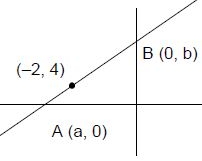
If a straight line passing through the point $P(-3, 4)$ is such that its intercepted portion between the coordinate axes is bisected at $P,$ then its equation is
  • A
    $3x-4y+25=0$
  • $4x-3y+24=0$
  • C
    $x-y+7=0$
  • D
    $4x+3y=0$

Answer

Correct option: B.
$4x-3y+24=0$
b
Let the line be $\frac{x}{a} + \frac{y}{b} = 1$

$\left( { - 3,4} \right) = \left( {\frac{a}{2},\frac{b}{2}} \right)$

$a=-6, b=8$

equation of line is 

$4x-3y+24=0$
Need a full question paper?

Generate a complete, print-ready paper with questions like this in minutes — across 16+ boards, with answer keys.

Start Generating Free

Similar questions

A bag contains $3$ black, $4$ white and $2$ red balls, all the ballsbeing different. Number of selections of atmost $6$ balls containing balls of all the colours is:
In numbers from $1$ to $100$ the digit $"0"$ appears $...........$ times:
Let the perpendiculars from any point on the line $7x + 56y = 0$ upon $3x + 4y = 0$ and $5x - 12y = 0$ be $p$ and $p,$ then:
Mark the correct answer for: $i ^{-38}=$ ?
The value of $\mathop {\lim }\limits_{x \to \infty } \sqrt {{a^2}{x^2} + ax + 1} - \sqrt {{a^2}{x^2} + 1} $ is
The equation of the circle which passes through the origin and cuts off intercepts of $2$ units length from negative coordinate axes, is
Let $f(x)=\sin \left(\frac{\pi}{6} \sin \left(\frac{\pi}{2} \sin x\right)\right)$ for all $x \in R$ and $g(x)=\frac{\pi}{2} \sin x$ for all $x \in R$. Let (f० g)(x) denote $f(g(x))$ and $(g \circ f)(x)$ denote $g(f(x))$. Then which of the following is (are) true ?

$(A)$ Range of $f$ is $\left[-\frac{1}{2}, \frac{1}{2}\right]$

$(B)$ Range of $f \circ g$ is $\left[-\frac{1}{2}, \frac{1}{2}\right]$

$(C)$ $\lim _{x \rightarrow 0} \frac{f(x)}{g(x)}=\frac{\pi}{6}$

$(D)$ There is an $x \in R$ such that $( g \circ f )(x)=1$

If $p$ and $q$ are non-zero real numbers and ${\alpha ^3} + {\beta ^3} =  - p$, $\alpha \beta  = q$, then a quadratic equation whose roots are $\frac{{{\alpha ^2}}}{\beta },\frac{{{\beta ^2}}}{\alpha }$ is
The focus of the parabola ${x^2} = - 16y$ is
If $\tan \theta = - \frac{1}{{\sqrt {10} }}$ and $\theta $ lies in the fourth quadrant, then $\cos \theta = $