MCQ
If a system is in thermodynamic equilibrium with its surroundings, it means:
  • A
    Temperature of system and surroundings must be same.
  • B
    Pressure, volume and temperature of system and surroundings must be same.
  • C
    Pressure, volume and temperature of system and surroundings may be different.
  • D
    None of the above.

Answer

  1. Temperature of system and surroundings must be same.

Need a full question paper?

Generate a complete, print-ready paper with questions like this in minutes — across 16+ boards, with answer keys.

Start Generating Free

Similar questions

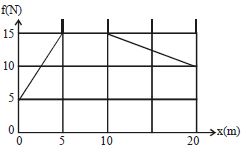
Figure here shows the frictional force versus displacement for a particle in motion. The loss of kinetic energy in travelling over $s = 0$ to $20\, m$ will be......$J$
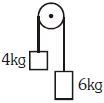
Two bodies of mass $4 \,kg$ and $6\, kg$ are tied to the ends of a massless string. The string passes over a pulley which is frictionless (see figure). The acceleration of the system in terms of acceleration due to gravity $(g)$ is 
Equation of travelling wave on a stretched string of linear density $5\,g/m$ is $y = 0.03\,sin\,(450\,t -9x)$ where distance and time are measured in $SI$ united. The tension in the string is ... $N$
When a car is taking a circular turn on a horizontal road, the centripetal force is the force of:
For any two vectors $\overrightarrow A $ and $\overrightarrow B $, if $\overrightarrow A \,.\,\overrightarrow B = \,\,|\overrightarrow A \times \overrightarrow B |,$ the magnitude of $\overrightarrow C = \overrightarrow A + \overrightarrow B $ is equal to
The range of a projectile fired at an angle of 15° is 50m. If it is fired with the same speed at an angle of 45°, its range will be:
  1. 25m
  2. 37m
  3. 50m
  4. 100m.
A homogeneous disc with a radius $0.2\, m$ and mass $5\, kg$ rotate around an axis passing through its centre. The angular velocity of the rotation of the disc as a function of time is given by the formula $\omega  = 2 + 6t$ . The tangential force applied to the rim of the disc is ........ $N.$
Which of the following quantity/quantities are dependent on the choice of orientation of the co-ordinate axes?

$(a)$ $\vec{a}+\vec{b}$

$(b)$ $3 a_x+2 b_y$

$(c)$ $(\vec{a}+\vec{b}-\vec{c})$

$A$ cone of radius $r$ and height $h$ rests on a rough horizontal surface, the coefficient of friction between the cone and the surface being $\mu$ . $A$ gradually increasing horizontal force $F$ is applied to the vertex of the cone. The largest value of $\mu$ for which the cone will slide before it topples is
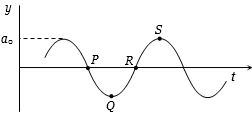
A wave motion has the function $y = {a_0}\sin (\omega \,t - kx)$. The graph in figure shows how the displacement $y$ at a fixed point varies with time $t$. Which one of the labelled points shows a displacement equal to that at the position $x = \frac{\pi }{{2k}}$ at time $t = 0$