MCQ
If a vector $2\hat i + 3\hat j + 8\hat k$ is perpendicular to the vector $4\hat j - 4\hat i + \alpha \hat k$. Then the value of $\alpha $ is
  • A
    $-1$
  • B
    $0.5$
  • $-0.5$
  • D
    $1$

Answer

Correct option: C.
$-0.5$
c
(c) Given vectors can be rewritten as $\overrightarrow A = 2\hat i + 3\hat j + 8\hat k$ and $\overrightarrow B = - 4\hat i + 4\hat j + \alpha \hat k$

Dot product of these vectors should be equal to zero because they are perpendicular.

$\therefore \overrightarrow A \,.\,\overrightarrow B = - 8 + 12 + 8\alpha = 0$ $⇒$ $8\alpha = - 4$ $⇒$ $\alpha = - 1/2$

Need a full question paper?

Generate a complete, print-ready paper with questions like this in minutes — across 16+ boards, with answer keys.

Start Generating Free

Similar questions

The angle of $1^{\prime}$ (minute of arc) in radian is nearly equal to
A bar magnet is cut into two equal parts then which of the following quantity may change

$(a)$ Intensity of magnetization

$(b)$ Pole strength

$(c)$ Magnetic moment
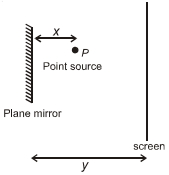
Shape of interference fringes formed on the screen due to point source $P$, in the case shown here
In $C.G.S$. system the magnitutde of the force is $100$ dynes. In another system where the fundamental physical quantities are kilogram, metre and minute, the magnitude of the force is
Two parallel beams of electrons moving in the same direction produce a mutual force
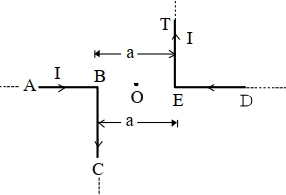
The magnitude of magnetic induction at mid-point $O$ due to current arrangement as shown in Fig will be
An electron from various excited states of hydrogen atom emit radiation to come to the ground state. Let $\lambda_v, \lambda_g$ be the de Broglie wavelength of the electron in the $n^{th}$ state and the ground state respectively. Let $\Lambda_n$ be the wavelength of the emitted photon in the transition from the $n^{th}$ state to the ground state. For large $n, (A, B $ are constants)
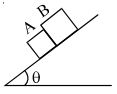
The two blocks $A$ and $B$ of equal mass are initially in contact when released from rest on the inclined plane. The coefficients of friction between the inclined plane $A$ and $B$ are $\mu_1$ and $\mu_2$ respectively.
Two bodies of mass $m$ and $9 m$ are placed at a distance $R$. The gravitational potential on the line joining the bodies where the gravitational field equals zero, will be ( $G=$ gravitational constant) :
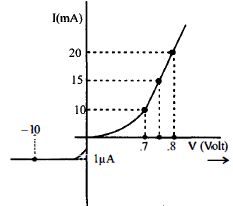
The $V-I$ characteristic of a diode is shown in the figure. The ratio of forward to reverse bias resistance is