MCQ
If a vector $\vec{A}$ is parallel to another vector $\vec{B}$ then the resultant of the vector $\vec{A} \times \vec{B}$ will be equal to
  • A
    $A$
  • B
    $\vec{A}$
  • Zero vector
  • D
    Zero

Answer

Correct option: C.
Zero vector
(c) $\vec{A} \times \vec{B}=A B \sin \theta \hat{n}$for parallel vectors $\theta=0^{\circ}$ or $180^{\circ}, \sin \theta=0$$\therefore \vec{A} \times \vec{B}=\hat{0}$

Need a full question paper?

Generate a complete, print-ready paper with questions like this in minutes — across 16+ boards, with answer keys.
Start Generating Free

Similar questions

A gas is suddenly compressed to $1 / 4$ th of its original volume at normal temperature. The increase in its temperature is $(\gamma=1.5)$
Two waves having the intensities in the ratio of $9: 1$ produce interference. The ratio of maximum to the minimum intensity, is equal to
The motion of planets in the solar system is an example of conservation of
A person uses spectacles of power $+2 D$. He is suffering from
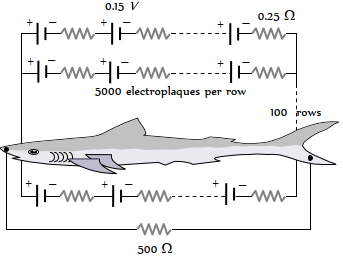
Eels are able to generate current with biological cells called electroplaques. The electroplaques in an eel are arranged in 100 rows, each row stretching horizontally along the body of the fish containing 5000 electroplaques. The arrangement is suggestively shown below. Each electroplaques has an emf of $0.15 \mathrm{~V}$ and internal resistance of $0.25 \Omega$

Image
The water surrounding the eel completes a circuit between the head and its tail. If the water surrounding it has a resistance of $500 \Omega$ the current an eel can produce in water is about
Which of the following is the disadvantage of FM over AM
An open pipe of length $I$ vibrates in fundamental mode. The pressure variation is maximum at
An elastic material of Young's modulus $Y$ is subjected to a stress $S$. The elastic energy stored per unit volume of the material is
Two masses of $1 \mathrm{gm}$ and $4 \mathrm{gm}$ are moving with equal kinetic energies. The ratio of the magnitudes of their linear momenta is
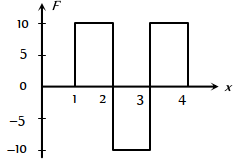
Figure shows the $F_{-x}$ graph. Where $F$ is the force applied and $x$ is the distance covered
by the body along a straight line path. Given that $F$ is in newton and $x$ in metre, what is the work done?
Image