MCQ 11 Mark
A vector $\vec{A}$ points vertically upward and $\vec{B}$ points towards north. The vector product $\vec{A} \times \vec{B}$ is
Answer(b) Direction of vector $A$ is along $z$-axis $\therefore \vec{A}=a \hat{k}$ Direction of vector $B$ is towards north $\therefore\vec{B}=\hat{b j}$Now $\vec{A} \times \vec{B}=a \hat{k} \times \hat{b j}=a b(-\hat{j})$$\therefore$ The direction is $\vec{A} \times \vec{B}$ is along west.
View full question & answer→MCQ 21 Mark
A truck travelling due north at $20 m / s$ turns west and travels at the same speed. The change in its velocity be
- A
$40 m / s N-W$
- B
$20 \sqrt{2} m / s N-W$
- C
$40 m / s S-W$
- ✓
$20 \sqrt{2} m / s S-W$
AnswerCorrect option: D. $20 \sqrt{2} m / s S-W$
View full question & answer→MCQ 31 Mark
If the resultant of $n$ forces of different magnitudes acting at a point is zero, then the minimum value of $n$ is
Answer(c) If vectors are of equal magnitude then two vectors can give zero resultant, if they works in opposite direction. But if the vectors are of different magnitudes then minimum three vectors are required to give zero resultant.
View full question & answer→MCQ 41 Mark
The vector projection of a vector $3 \hat{i}+4 \hat{k}$ on $y$-axis is
Answer(d) As the multiple of $\hat{j}$ in the given vector is zero therefore this vector lies in $X Z$ plane and projection of this vectoron $y$-axis is zero.
View full question & answer→MCQ 51 Mark
A plane is revolving around the earth with a speed of $100 km / hr$ at a constant height from the surface of earth. The change in the velocity as it travels half circle is
- ✓
$200 km / hr$
- B
$150 km / hr$
- C
$100 \sqrt{2} km / hr$
AnswerCorrect option: A. $200 km / hr$
(a)$\begin{aligned}& \Delta v=2 v \sin \left(\frac{\theta}{2}\right)=2 \times v \times \sin 90^{\circ} \\& =2 \times 100=200 km / hr\end{aligned}$
View full question & answer→MCQ 61 Mark
The value of $(\vec{A}+\vec{B}) \times(\vec{A}-\vec{B})$ is
AnswerCorrect option: D. $2(\vec{B} \times \vec{A})$
(d)$\begin{aligned}& (\vec{A}+\vec{B}) \times(\vec{A}-\vec{B})=\vec{A} \times \vec{A}-\vec{A} \times \vec{B}+\vec{B} \times \vec{A}-\vec{B} \times \vec{B} \\& =0-\vec{A} \times \vec{B}+\vec{B} \times \vec{A}-0=\vec{B} \times \vec{A}+\vec{B} \times \vec{A}=2(\vec{B} \times \vec{A})\end{aligned}$
View full question & answer→MCQ 71 Mark
The sum of the magnitudes of two forces acting at point is 18 and the magnitude of their resultant is 12 . If the resultant is at $90^{\circ}$ with the force of smaller magnitude, what are the, magnitudes of forces
View full question & answer→MCQ 81 Mark
The angle between the two vectors $\vec{A}=3 \hat{i}+4 \hat{j}+5 \hat{k}$ and $\vec{B}=3 \hat{i}+4 \hat{j}-5 \hat{k}$ will be
- ✓
$90^{\circ}$
- B
$0^{\circ}$
- C
$60^{\circ}$
- D
$45^{\circ}$
AnswerCorrect option: A. $90^{\circ}$
(a)$\begin{aligned}& \cos \theta=\frac{\vec{A} \cdot \vec{B}}{|A||B|}=\frac{(3 \hat{i}+4\hat{j}+5 \hat{k})(3 \hat{i}+4 \hat{j}-5 \hat{k})}{\sqrt{9+16+25} \sqrt{9+16+25}} \\&=\frac{9+16-25}{50}=0 \\& \Rightarrow \cos \theta=0, \therefore \theta=90^{\circ\end{aligned}$
View full question & answer→MCQ 91 Mark
If a vector $\vec{A}$ is parallel to another vector $\vec{B}$ then the resultant of the vector $\vec{A} \times \vec{B}$ will be equal to
Answer(c) $\vec{A} \times \vec{B}=A B \sin \theta \hat{n}$for parallel vectors $\theta=0^{\circ}$ or $180^{\circ}, \sin \theta=0$$\therefore \vec{A} \times \vec{B}=\hat{0}$
View full question & answer→MCQ 101 Mark
When $\vec{A} \cdot \vec{B}=-|A||B|$, then
- A
$\vec{A}$ and $\vec{B}$ are perpendicular to each other
- B
$\vec{A}$ and $\vec{B}$ act in the same direction
- ✓
$\vec{A}$ and $\vec{B}$ act in the opposite direction
- D
$\vec{A}$ and $\vec{B}$ can act in any direction
AnswerCorrect option: C. $\vec{A}$ and $\vec{B}$ act in the opposite direction
(c) $\vec{A} \cdot \vec{B}=A B \cos \theta$In the problem $\vec{A} \cdot \vec{B}=-A B$ i.e. $\cos \theta=-1 \therefore \theta=180^{\circ}$ i.e. $\vec{A}$ and $\vec{B}$ acts in the opposite direction.
View full question & answer→MCQ 111 Mark
A force $\vec{F}(5 \hat{i} 3 \hat{j})$ Newton is applied over a particle which displaces it from its origin to the point $\vec{r}(2 \hat{i} 1 \hat{j})$ metres. The work done on the particle is
- A
$-7 J$
- B
$+13 J$
- ✓
$+7 J$
- D
$+11 J$
AnswerCorrect option: C. $+7 J$
(c) $W=\vec{F} \cdot \vec{r}=(5 \hat{i}+3 \hat{j})(2 \hat{i}-\hat{j})=10-3=7)$.
View full question & answer→MCQ 121 Mark
A vector $\vec{F}_1$ is along the positive $X$-axis. If its vector product with another vector $\vec{F}_2$ is zero then $\vec{F}_2$ could be
- A
$4 \hat{j}$
- B
$-(\hat{i}+\hat{j})$
- C
$(\hat{j}+\hat{k})$
- ✓
$(-4 \hat{i})$
AnswerCorrect option: D. $(-4 \hat{i})$
View full question & answer→MCQ 131 Mark
Consider two vectors $\vec{F}_1 \quad 2 \hat{i} \quad 5 \hat{k}$ and $\vec{F}_2 \quad 3 \hat{j} \quad 4 \hat{k}$. The magnitude of the scalar product of these vectors is
Answer(d)$\begin{aligned}& \vec{F}_1 \cdot \vec{F}_2=(2 \hat{j}+5 \hat{k})(3 \hat{j}+4 \hat{k}) \\& =6+20=20+6=26\end{aligned$
View full question & answer→MCQ 141 Mark
A particle moves towards east with velocity $5 m / s$. After 10 seconds its direction changes towards north with same velocity. The average acceleration of the particle is
- A
- ✓
$\frac{1}{\sqrt{2}} m / s^2 N-W$
- C
$\frac{1}{\sqrt{2}} m / s^2 N-E$
- D
$\frac{1}{\sqrt{2}} m / s^2 S-W$
AnswerCorrect option: B. $\frac{1}{\sqrt{2}} m / s^2 N-W$
(b) $\Delta v=2 v \sin \left(\frac{\theta}{2}\right)=2 \times 5 \times \sin 45^{\circ=\frac{10}{\sqrt{2}}$$\therefore a=\frac{\Delta v}{\Delta t}=\frac{10 /\sqrt{2}}{10}=\frac{1}{\sqrt{2}} m / s ^2$
View full question & answer→MCQ 151 Mark
A particle moves in the $x-y$ plane under the action of a force $\vec{F}$ such that the value of its linear momentum $(\vec{P})$ at anytime $t$ is $P_x=2 \cos t, p_y=2 \sin t$. The angle $\theta$ between $\vec{F}$ and $\vec{P}$ at a given time $t$. will be
- A
$\theta=0^{\circ}$
- B
$\theta=30^{\circ}$
- ✓
$\theta=90^{\circ}$
- D
$\theta=180^{\circ}$
AnswerCorrect option: C. $\theta=90^{\circ}$
(c) $P _{ x }=2 \operatorname{cost}, P _{ y }=2 \operatorname{sint}\therefore\overrightarrow{ P }=2 \operatorname{cost} \hat{ i }+2 \operatorname{sint} \hat{ j }$$\vec{F}=\frac{d \vec{P}}{d t}=-2 \operatorname{sint} \hat{i}+2 \operatorname{cost} \hat{j}$$\vec{F} \cdot \vec{P}=0 \therefore \theta=90^{\circ}$
View full question & answer→MCQ 161 Mark
View full question & answer→MCQ 171 Mark
If for two vector $\vec{A}$ and $\vec{B}$, sum $(\vec{A} \quad \vec{B})$ is perpendicular to the difference $\left(\begin{array}{ll}A & \vec{B}\end{array}\right)$. The ratio of their magnitude is
Answer(a) $(\vec{A}+\vec{B})$ is perpendicular to $(\vec{A}-\vec{B})$. Thus$\begin{aligned}& (\vec{A}+\vec{B}) \cdot(\vec{A}-\vec{B})=0 \\& \text { or } A^2+\vec{B} \cdot \vec{A}-\vec{A} \cdot \vec{B}-B^2=0\end{aligned}$Because of commutative property of dot product $\vec{A} \cdot \vec{B}=\vec{B} \cdot \vec{A}$$\therefore A^2-B^2=0 \text { or } A=B$Thus the ratio of magnitudes $A / B=1$
View full question & answer→MCQ 181 Mark
Two forces of $12 N$ and $8 N$ act upon a body. The resultant force on the body has maximum value of
- A
$4 N$
- B
$0 N$
- ✓
$20 N$
- D
$8 N$
AnswerCorrect option: C. $20 N$
(c) $R_{\max }=A+B$ when $\theta=0^{\circ} \therefore R_{\max }=12+8=20 N$
View full question & answer→MCQ 191 Mark
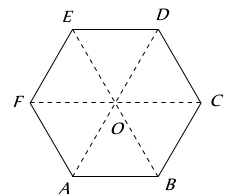
Figure shows $A B C D E F$ as a regular hexagon. What is the value of $\overrightarrow{A B}+\overrightarrow{A C}+\overrightarrow{A D}+\overrightarrow{A E}+\overrightarrow{A F}$
- A
$\overrightarrow{A O}$
- B
$2 \overrightarrow{A O}$
- C
$4 \overrightarrow{A O}$
- ✓
$6 \overrightarrow{A O}$
AnswerCorrect option: D. $6 \overrightarrow{A O}$
View full question & answer→MCQ 201 Mark
If force $(\vec{F})=4 \hat{i}+5 \hat{j}$ and displacement $(\vec{s})=3 \hat{i}+6 \hat{k}$ then the work done is
- ✓
$4 \times 3$
- B
$5 \times 6$
- C
$6 \times 3$
- D
$4 \times 6$
AnswerCorrect option: A. $4 \times 3$
(a) $W=\vec{F} \vec{S}=(4 \hat{i}+5 \hat{j})(3 \hat{i}+6 \hat{j})=12$
View full question & answer→MCQ 211 Mark
With respect to a rectangular cartesian coordinate system, three vectors are expressed as $\vec{a}=4 \hat{i}-\hat{j}, \vec{b}=-3 \hat{i}+2 \hat{j}$ and $\vec{c}=-\hat{k}$ where $\hat{i}, \hat{j}, \hat{k}$ are unit vectors, along the $X, Y$ and $Z$-axis respectively. The unit vectors $\hat{r}$ along the direction of sum of these vector is
- ✓
$\hat{r}=\frac{1}{\sqrt{3}}(\hat{i}+\hat{j}-\hat{k})$
- B
$\hat{r}=\frac{1}{\sqrt{2}}(\hat{i}+\hat{j}-\hat{k})$
- C
$\hat{r}=\frac{1}{3}(\hat{i}-\hat{j}+\hat{k})$
- D
$\hat{r}=\frac{1}{\sqrt{2}}(\hat{i}+\hat{j}+\hat{k})$
AnswerCorrect option: A. $\hat{r}=\frac{1}{\sqrt{3}}(\hat{i}+\hat{j}-\hat{k})$
(a)$\begin{aligned}& \vec{r}=\vec{a}+\vec{b}+\vec{c}=4 \hat{i}-\hat{j}-3 \hat{i +2\hat{j}-\hat{k}=\hat{i}+\hat{j}-\hat{k} \\& \hat{r}=\frac{\vec{r}}{|r|}=\frac{\hat{i}\hat{j}-\hat{k}}{\sqrt{1^2+1^2+(-1)^2}}=\frac{\hat{i}+\hat{j}-\hat{k}}{\sqrt{3}}\end{aligned}$
View full question & answer→MCQ 221 Mark
The maximum and minimum magnitude of the resultant of two given vectors are 17 units and 7 unit respectively. If these two vectors are at right angles to each other, the magnitude of their resultant is
Answer(d)$\begin{aligned}& R_{\max }=A+B=17 \text { when } \theta=0^{\circ} \\& R_{\min }=A-B=7 \text { when } \theta=180^{\circ}\end{aligned$by solving we get $A=12$ and $B=5$Now when $\theta=90^{\circ}$ then $R=\sqrt{A^2+B^2}$$\Rightarrow R=\sqrt{(12)^2+(5)^2 =\sqrt{169}=13]
View full question & answer→MCQ 231 Mark
A force $\overrightarrow{ F } 5 \hat{i} \quad 6 \hat{j} 4 \hat{k}$ acting on a body, produces a displacement $\overrightarrow{ S } \quad 6 \hat{i} \quad 5 \hat{k}$. Work done by the force is
Answer(a) $W =\overline{ F } \cdot \overline{ s }=(5 \hat{ i }+6 \hat{ j }+4 \hat{ k })(6 \hat{i }-5 \hat{ k })=30-20=10$ J
View full question & answer→MCQ 241 Mark
The component of vector $A=2 \hat{i}+3 \hat{j}$ along the vector $\hat{i}+\hat{j}$ is
- ✓
$\frac{5}{\sqrt{2}}$
- B
$10 \sqrt{2}$
- C
$5 \sqrt{2}$
- D
AnswerCorrect option: A. $\frac{5}{\sqrt{2}}$
(a) $\frac{\vec{A} \cdot \vec{B}}{|\vec{i}+\vec{j}|}=\frac{(2 \hat{i}+3 \hat{j})(\hat{i}+\hat{j})}{\sqrt{2}}=\frac{2+3}{\sqrt{2}}=\frac{5}{\sqrt{2}}$
View full question & answer→MCQ 251 Mark
- ✓
- B
- C
Neither scalar nor vector
- D
Answer(a) $\quad \phi=\vec{B} \cdot \vec{A}$. In this formula $\vec{A}$ is a area vector.
View full question & answer→MCQ 261 Mark
Three concurrent forces of the same magnitude are in equilibrium. What is the angle between the forces ? Also name the triangle formed by the forces as sides
- ✓
$60^{\circ}$ equilateral triangle
- B
$120^{\circ}$ equilateral triangle
- C
$120^{\circ}, 30^{\circ}, 30^{\circ}$ an isosceles triangle
- D
$120^{\circ}$ an obtuse angled triangle
AnswerCorrect option: A. $60^{\circ}$ equilateral triangle
(a) In $N$ forces of equal magnitude works on a single point and their resultant is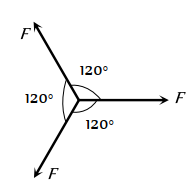
zero then angle between any two forces is given$\theta=\frac{360}{N}=\frac{360}{3}=120^{\circ}$If these three vectors are represented by three sides of triangle then they form equilateral triangle View full question & answer→MCQ 271 Mark
The vectors from origin to the points $A$ and $B$ are $\vec{A}=3 \hat{i}-6 \hat{j}+2 \hat{k}$ and $\vec{B}=2 \hat{i}+\hat{j}-2 \hat{k}$ respectively. The area of the triangle $O A B$ be
- ✓
$\frac{5}{2} \sqrt{17}$ sq.unit
- B
$\frac{2}{5} \sqrt{17}$ sq.unit
- C
$\frac{3}{5} \sqrt{17}$ sq.unit
- D
$\frac{5}{3} \sqrt{17}$ sq.unit
AnswerCorrect option: A. $\frac{5}{2} \sqrt{17}$ sq.unit
View full question & answer→MCQ 281 Mark
A man crosses a $320 m$ wide river perpendicular to the current in 4 minutes. If in still water he can swim with a speed $5 / 3$ times that of the current, then the speed of the current, in $m / min$ is
View full question & answer→MCQ 291 Mark
Can the resultant of 2 vectors be zero
AnswerCorrect option: C. Yes, when the 2 vectors are same in magnitude but opposite in sense
View full question & answer→MCQ 301 Mark
Two forces $3 N$ and $2 N$ are at an angle $\theta$ such that the resultant is $R$. The first force is now increased to $6 N$ and the resultant become $2 R$. The value of $\theta$ is
- A
$30^{\circ}$
- B
$60^{\circ}$
- C
$90^{\circ}$
- ✓
$120^{\circ}$
AnswerCorrect option: D. $120^{\circ}$
View full question & answer→MCQ 311 Mark
A man sitting in a bus travelling in a direction from west to east with a speed of $40 km / h$ observes that the rain-drops are falling vertically down. To the another man standing on ground the rain will appear
- A
- ✓
To fall at an angle going from west to east
- C
To fall at an angle going from east to west
- D
The information given is insufficient to decide the direction of rain.
AnswerCorrect option: B. To fall at an angle going from west to east
View full question & answer→MCQ 321 Mark
A boy walks uniformally along the sides of a rectangular park of size $400 m \times 300 m$, starting from one corner to the other corner diagonally opposite. Which of the following statement is incorrect
- A
He has travelled a distance of $700 m$
- ✓
His displacement is $700 m$
- C
His displacement is $500 m$
- D
His velocity is not uniform throughout the walk
AnswerCorrect option: B. His displacement is $700 m$
Displacement $\vec{A} C=\vec{A} B+\vec{B} C$
$A C=\sqrt{(A B)^2+(B C)^2}=\sqrt{(400)^2+(300)^2}$
$ =500 m $
$ \text { Distance }=A B+B C=400+300=700\ m$
View full question & answer→MCQ 331 Mark
Which pair of the following forces will never give resultant force of $2 N$
- A
$2 N$ and $2 N$
- B
$1 N$ and $1 N$
- C
$1 N$ and $3 N$
- ✓
$1 N$ and $4 N$
AnswerCorrect option: D. $1 N$ and $4 N$
View full question & answer→MCQ 341 Mark
The angle between two vectors given by $6 \bar{i}+6 \bar{j}-3 \bar{k}$ and $7 \bar{i}+4 \bar{j}+4 \bar{k}$ is
- A
$\cos ^{-1}\left(\frac{1}{\sqrt{3}}\right)$
- B
$\cos ^{-1}\left(\frac{5}{\sqrt{3}}\right)$
- C
$\sin ^{-1}\left(\frac{2}{\sqrt{3}}\right)$
- ✓
$\sin ^{-1}\left(\frac{\sqrt{5}}{3}\right)$
AnswerCorrect option: D. $\sin ^{-1}\left(\frac{\sqrt{5}}{3}\right)$
(d)$\begin{aligned}& \cos \theta=\frac{\vec{A} \vec{B}}{A B}=\frac{42+24-12}{\sqrt{36+36+9} \sqrt{49+16+16}}=\frac{56}{9 \sqrt{71}} \\\cos \theta=\frac{56}{9 \sqrt{71}} \therefore \sin \theta=\frac{\sqrt{5}}{3} \text { or } \theta=\sin ^{-1}\left(\frac{\sqrt{5}}{3}\right)\end{aligned}$
View full question & answer→MCQ 351 Mark
The angle made by the vector $A=\hat{i}+\hat{j}$ with $x$ - axis is
- A
$90^{\circ}$
- ✓
$45^{\circ}$
- C
$22.5^{\circ}$
- D
$30^{\circ}$
AnswerCorrect option: B. $45^{\circ}$
(b)$\begin{aligned}& \vec{A}=\hat{i}+\hat{j} \Rightarrow|A|=\sqrt{1^2+1^2}=\sqrt{2} \\& \cos \alpha=\frac{A_x}{|A|}=\frac{1}{\sqrt{2}}=\cos 45^{\circ} \therefore \alpha=45^{\circ}\end{aligned}$
View full question & answer→MCQ 361 Mark
The unit vector parallel to the resultant of the vectors $\vec{A}=4 \hat{i}+3 \hat{j}+6 \hat{k}$ and $\vec{B}=-\hat{i}+3 \hat{j}-8 \hat{k}$ is
- ✓
$\frac{1}{7}(3 \hat{i}+6 \hat{j}-2 \hat{k})$
- B
$\frac{1}{7}(3 \hat{i}+6 \hat{j}+2 \hat{k})$
- C
$\frac{1}{49}(3 \hat{i}+6 \hat{j}-2 \hat{k})$
- D
$\frac{1}{49}(3 \hat{i}-6 \hat{j}+2 \hat{k})$
AnswerCorrect option: A. $\frac{1}{7}(3 \hat{i}+6 \hat{j}-2 \hat{k})$
View full question & answer→MCQ 371 Mark
The angle between the vectors $(\hat{i} \quad \hat{j})$ and $(\hat{j} \quad \hat{k})$ is
- A
$30^{\circ}$
- B
$45^{\circ}$
- ✓
$60^{\circ}$
- D
$90^{\circ}$
AnswerCorrect option: C. $60^{\circ}$
(c)$\begin{aligned}& (\hat{i}+\hat{j}) \cdot(\hat{j}+\hat{k})=0+0+1+0=1 \\& \cos \theta=\frac{\vec{A} \cdot \vec{B}}{|\vec{A}||\vec{B}|}=\frac{1}{\sqrt{2} \times \sqrt{2}=\frac{1}{2} \therefore \theta=60^{\circ}\end{aligned}$
View full question & answer→MCQ 381 Mark
If $\vec{A}$ and $\vec{B}$ are perpendicular vectors and vector $\vec{A}=5 \hat{i}+7 \hat{j}-3 \hat{k}$ and $\vec{B}=2 \hat{i}+2 \hat{j}-a \hat{k}$. The value of $a$ is
Answer(d) For perpendicular vector $\vec{A} \cdot \vec{B}=0$$\begin{aligned}& \Rightarrow(5 \hat{i}+7 \hat{j}-3 \hat{k}) \cdot(2 \hat{i}+2 \hat{j}-a \hat{k})=0 \\& \Rightarrow 10+14+3 a=0 \Rightarrow a=-8\end{aligned}$
View full question & answer→MCQ 391 Mark
A boat takes two hours to travel $8 km$ and back in still water. If the velocity of water is $4 km / h$, the time taken for going upstream $8 km$ and coming back is
- A
$2 h$
- ✓
$2 h 40 min$
- C
$1 h 20 min$
- D
Cannot be estimated with the information given
AnswerCorrect option: B. $2 h 40 min$
(b) Boat covers distance of $16 km$ in a still water in 2 hours.i.e. $v_B=\frac{16}{2}=8 km / hr$Now velocity of water $\Rightarrow v_w=4 km / hr$.Time taken for going upstream$t_1=\frac{8}{v_B-v_w}=\frac{8}{8-4}=2 h r$(As water current oppose the motion of boat) Time taken for going down stream$t_2=\frac{8}{v_B+v_w}=\frac{8}{8+4}=\frac{8}{12} h r$(As water current helps the motion of boat)$\therefore$ Total time $=t_1+t_2=\left(2+\frac{8}{12}\right) h r$ or $2 h r 40 min$
View full question & answer→MCQ 401 Mark
The position vector of a particle is determined by the expression $\vec{r}=3 t^2 \hat{i}+4 t^2 \hat{j}+7 \hat{k}$ The distance traversed in first $10 sec$ is
- ✓
$500 m$
- B
$300 m$
- C
$150 m$
- D
$100 m$
AnswerCorrect option: A. $500 m$
View full question & answer→MCQ 411 Mark
The angle between the two vectors $\vec{A}=3 \hat{i}+4 \hat{j}+5 \hat{k}$ and $\vec{B}=3 \hat{i}+4 \hat{j}+5 \hat{k}$ is
- A
$60^{\circ}$
- B
- C
$90^{\circ}$
- ✓
Answer(d)$\begin{aligned}& \cos \theta=\frac{\vec{A} \cdot \vec{B}}{|A||B|}=\frac{9+16+25}{\sqrt{9+16+25} \sqrt{9+16+25}}=\frac{50}{50}=1 \\& \Rightarrow \cos \theta=1 \quad \therefore \quad \theta=\cos ^{-1}(1)\end{aligned}$
View full question & answer→MCQ 421 Mark
A force $\vec{F}=3 \hat{i}+\hat{c j}+2 \hat{k}$ acting on a particle causes a displacement $\vec{S}=-4 \hat{i}+2 \hat{j}-3 \hat{k}$ in its own direction. If the work done is 6J, then the value of $c$ will be
Answer(a)$W=\vec{F} \cdot s=(3 \hat{i}+\hat{c j}+2 \hat{k}) \cdot(-4 \hat{i}+2 \hat{j}-3 \hat{k})=-12+2 c-6$Work done $=6 J$ (given)$\therefore-12+2 c-6=6 \Rightarrow c=12$
View full question & answer→MCQ 431 Mark
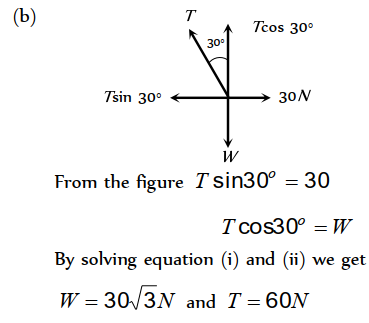
As shown in figure the tension in the horizontal cord is $30 N$. The weight $W$ and tension in the string $O A$ in Newton are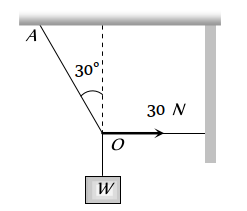
- A
$30 \sqrt{ } 30$
- ✓
$30 \sqrt{ } 60$
- C
$60 \sqrt{30}$
- D
AnswerCorrect option: B. $30 \sqrt{ } 60$
(b)
View full question & answer→MCQ 441 Mark
The length of second's hand in watch is $1 cm$. The change in velocity of its tip in 15 seconds is
- A
- B
$\frac{\pi}{30 \sqrt{2}} cm / sec$
- C
$\frac{\pi}{30} cm / sec$
- ✓
$\frac{\pi \sqrt{2}}{30} cm / sec$
AnswerCorrect option: D. $\frac{\pi \sqrt{2}}{30} cm / sec$
(d)$\begin{aligned}& \Delta v=2 v \sin \left(\frac{90^{\circ}}{2}\right)=2 v \sin45^{\circ}=2 v \times \frac{1}{\sqrt{2}}=\sqrt{2} v \\& =\sqrt{2} \times r\omega=\sqrt{2} \times 1 \times \frac{2 \pi}{60}=\frac{\sqrt{2} \pi}{30} cm /s\end{aligned}$
View full question & answer→MCQ 451 Mark
The angle between the two vectors $\vec{A}=5 \hat{i}+5 \hat{j}$ and $\vec{B}=5 \hat{i}-5 \hat{j}$ will be
- A
- B
$45^{\circ}$
- ✓
$90^{\circ}$
- D
$180^{\circ}$
AnswerCorrect option: C. $90^{\circ}$
(c) $\overrightarrow{ A } \cdot \overrightarrow{ B }=0 \therefore \theta=90^{\circ}$
View full question & answer→MCQ 461 Mark
A force $\vec{F}=-K(y \hat{i}+\hat{x j})$ (where $K$ is a positive constant) acts on a particle moving in the $x-y$ plane. Starting from the origin, the particle is taken along the positive $x$ - axis to the point $(a, 0)$ and then parallel to the $y$-axis to the point $(a, a)$. The total work done by the forces $\vec{F}$ on the particle is
- A
$-2 K a^2$
- B
$2 Ka ^2$
- ✓
$-K a^2$
- D
$K a^2$
AnswerCorrect option: C. $-K a^2$
View full question & answer→MCQ 471 Mark
Find the torque of a force $\vec{F}=-3 \hat{i}+\hat{j}+5 \hat{k}$ acting at the point $\vec{r}=7 \hat{i}+3 \hat{j}+\hat{k}$
- ✓
$14 \hat{i}-38 \hat{j}+16 \hat{k}$
- B
$4 \hat{i}+4 \hat{j}+6 \hat{k}$
- C
$2 \hat{i}+4 \hat{j}+4 \hat{k}$
- D
$-14 \hat{i}+34 \hat{j}-16 \hat{k}$
AnswerCorrect option: A. $14 \hat{i}-38 \hat{j}+16 \hat{k}$
(a)$\begin{aligned}\vec{\tau} & =\vec{r} \times \vec{F}=(7 \hat{i}+3 \hat{j}+\hat{k})(-3 \hat{i}+\hat{j}+5 \hat{k}) \\\vec{\tau} & =\left|\begin{array}{ccc}\hat{i} & \hat{j} & \hat{k} \\7 & 3 & 1 \\-3 & 1 & 5\end{array}\right|=14 \hat{i}-38 \hat{j}+16 \hat{k}\end{aligned}$
View full question & answer→MCQ 481 Mark
The sum of two forces acting at a point is $16 N$. If the resultant force is $8 N$ and its direction is perpendicular to minimum force then the forces are
- ✓
$6 N$ and $10 N$
- B
$8 N$ and $8 N$
- C
$4 N$ and $12 N$
- D
$2 N$ and $14 N$
AnswerCorrect option: A. $6 N$ and $10 N$
(a)$\begin{aligned}& A+B=16 \text { (given) } \\& \tan \alpha=\frac{B \sin \theta}{A+B \cos \theta}=\tan 90^{\circ} \\& \therefore \quad A+B \cos \theta=0 \Rightarrow \cos \theta=\frac{-A}{B}\end{aligned}$$8=\sqrt{2^2+{ }^2+2 \cos \theta}$By solving eq. (i), (ii) and (iii) we get $=6, \quad=10$
View full question & answer→MCQ 491 Mark
If the sum of two unit vectors is a unit vector, then magnitude of difference is
- A
$\sqrt{2}$
- ✓
$\sqrt{3}$
- C
$1 / \sqrt{2}$
- D
$\sqrt{5}$
AnswerCorrect option: B. $\sqrt{3}$
View full question & answer→MCQ 501 Mark
Given vector $\vec{A}=2 \hat{i}+3 \hat{j}$, the angle between $\vec{A}$ and $y$-axis is
- A
$\tan ^{-1} 3 / 2$
- ✓
$\tan ^{-1} 2 / 3$
- C
$\sin ^{-1} 2 / 3$
- D
$\cos ^{-1} 2 / 3$
AnswerCorrect option: B. $\tan ^{-1} 2 / 3$
View full question & answer→