MCQ
If $\overrightarrow A \times \overrightarrow B=\overrightarrow B \times \overrightarrow A$ then the angle between $\overrightarrow A$ and $\overrightarrow B$ is
  • A
    $\pi / 2$
  • B
    $\pi / 3$
  • $\pi$
  • D
    $\pi / 4$

Answer

Correct option: C.
$\pi$
c
(c) We know that $\overrightarrow A \times \overrightarrow B = - (\overrightarrow B \times \overrightarrow A )$ because the angle between these two is always $90^°$.

But if the angle between $\overrightarrow A $ and $\overrightarrow B $ is $0^°$. Then $\overrightarrow A \times \overrightarrow B = \overrightarrow B \times \overrightarrow A = 0$.

Need a full question paper?

Generate a complete, print-ready paper with questions like this in minutes — across 16+ boards, with answer keys.
Start Generating Free

Similar questions

A proton, a deuteron and an $\alpha-$particle with same kinetic energy enter into a uniform magnetic field at right angle to magnetic field. The ratio of the radii of their respective circular paths is
The temperature of an ideal gas at atmospheric pressure is $300\,K$ and volume $1\,m^3$. If temperature and volume become double, then pressure will be
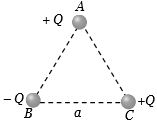
Three charges are placed at the vertices of an equilateral triangle of side ‘$a$’ as shown in the following figure. The force experienced by the charge placed at the vertex $A$ in a direction normal to $BC$ is
The charge given to any conductor resides on its outer surface, because
Two projectiles are thrown simultaneously in the same plane from the same point. If their velocities are $v_1$ and $v_2$ at angles $\theta _1$ and $\theta_2$ respectively from the horizontal, then answer the following question

If $v_1\,\,sin\,\,\theta _1 = v_2\,\,sin\,\,\theta _2$, then choose the incorrect statement

Which of the following is smallest unit
Carbon-$11$ decays to boron-$11$ according to the following formula.

${ }_6^{11} C \rightarrow{ }_5^{11} B +e^{+}+ v _e+0.96 \,MeV$

Assume that, positrons $\left(e^{+}\right)$produced in the decay combine with free electrons in the atmosphere and annihilate each other almost immediately. Also, assume that the neutrinos $\left(v_e\right)$ are massless and do not interact with the environment. At $t=0$, we have $1 \mu g$ of ${ }_6^{12} C$. If the half-life of the decay process is $t_0$, the net energy produced between time $t=0$ and $t=2 t_0$, will be nearly ........... $MeV$
If a charged spherical conductor of radius $10\,cm$ has potential $V$ at a point distant $5\,cm$ from its centre, then the potential at a point distant $15\,cm$ from the centre will be
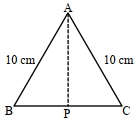
Cross-section view of a prism is the equilateral triangle ${ABC}$ in the figure. The minimum deviation is observed using this prism when the angle of incidence is equal to the prism angle. The time taken by light to travel from midpoint of ${BC}$ to ${A}$ is $.....\times 10^{-10}\, {s}$. $($ Given, speed of light in vacuum $=3 \times 10^{8} \,{m} / {s}$ and $\left.\cos 30^{\circ}=\frac{\sqrt{3}}{2}\right)$
In a co-axial straight cable, the central conductor and the outer conductor carry equal currents in opposite directions. The magnetic field is zero.