MCQ
If $\overrightarrow A \times \overrightarrow B=\overrightarrow B \times \overrightarrow A$ then the angle between $\overrightarrow A$ and $\overrightarrow B$ is
  • A
    $\pi / 2$
  • B
    $\pi / 3$
  • $\pi$
  • D
    $\pi / 4$

Answer

Correct option: C.
$\pi$
c
(c) We know that $\overrightarrow A \times \overrightarrow B = - (\overrightarrow B \times \overrightarrow A )$ because the angle between these two is always $90^°$.

But if the angle between $\overrightarrow A $ and $\overrightarrow B $ is $0^°$. Then $\overrightarrow A \times \overrightarrow B = \overrightarrow B \times \overrightarrow A = 0$.

Need a full question paper?

Generate a complete, print-ready paper with questions like this in minutes — across 16+ boards, with answer keys.
Start Generating Free

Similar questions

Let $V$ and $E$ denote the gravitational potential and gravitational field at a point. It is possible to have:
  1. $V = 0$ and $E = 0$
  2. $V = 0$ and $E \neq 0$
  3. $V \neq 0$ and $E = 0$
  4. $V \neq 0$ and $E \neq 0$
A projectile is thrown with a velocity of $50\,\, ms^{^{-1}}$ at an angle of $53^o$ with the horizontal Determine the instants at which the projectile is at the same height
With rise in temperature, density of a given body changes according to one of the following relations
Two particles of equal mass have velocities $2\,\hat i\, ms^{-1}$ and $2\,\hat j\, ms^{-1}$. First particle has an acceleration $(\,\hat i\, + \,\hat j\,)$ $ms^{-2}$ while the acceleration of the second particle is zero. The centre of mass of the two particles moves in
A system consists of $3$  particles each of mass $m$ and located at $(1, 1), (2, 2), (3, 3)$. The co-ordinate of the centre of mass are
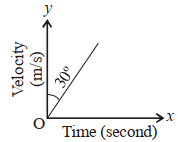
The velocity-time graph for one-dimensional motion of a particle is as shown in the figure. The acceleration of the particle is (in $m / s ^2$ ):
Image
The centre of a wheel rolling on a plane surface moves with a speed $v_0$. A particle on the rim of the wheel at the same level as the centre will be moving at speed:
The area of cross-section of a railway track is $0.01\, {m}^{2}$. The temperature variation is $10^{\circ} {C}$. Coefficient of linear expansion of material of track is $10^{-5} /{ }^{\circ} {C}$. The energy stored per meter in the track is ...... ${J} / {m} .$

(Young's modulus of material of track is $10^{11} \,{Nm}^{-2}$ ))

When a ceiling fan is switched on, it makes $10$ rotations in first $3\,seconds,$ How many rotations will it make in the next $3\,seconds.$ (Assume uniform angular acceleration)
In the context of accuracy of measurement and significant figures in expressing results of experiment, which of the following is/are correct

$(1)$ Out of the two measurements $50.14 \,cm$ and $0.00025$ ampere, the first one has greater accuracy

$(2)$ If one travels $478\, km$ by rail and $397\, m$. by road, the total distance travelled is $478\, km.$