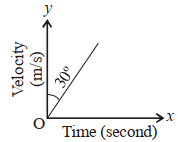
Answer

Correct option: A.
 (a) Acceleration $a=\frac{ dv }{ dt }=\tan \theta$
Here, $\theta$ is the angle made with the x axis.
$\begin{array}{ll}
\therefore \quad & \theta=90^{\circ}-30^{\circ}=60^{\circ} \\
& a=\tan 60^{\circ}=\sqrt{3}
\end{array}$
Hence, the correct option is (a).

Need a full question paper?

Generate a complete, print-ready paper with questions like this in minutes — across 16+ boards, with answer keys.
Start Generating Free

Similar questions

A particle is acted upon by a force of constant magnitude which is always perpendicular to the velocity of the particle. The motion of the particle takes place in a plane. It follows that  
Calculate radiation power for sphere whose temperature is $227^{\circ} C$ and radius $2\, m$ and emissivity $0.8$ (in $W$)
A particle performs harmonic oscillations along a straight line with a period of $6s$ and amplitude $4\ cm.$ The mean velocity of the particle averaged over the time interval during which it travels a distance of $2\ cm$ starting from the extreme position is:
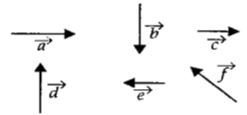
Six vectors, $\overrightarrow a$ through $\overrightarrow f$ have the magnitudes and directions indicated in the figure. Which of the following statements is true ?
A bar of iron is $10\ cm$ at $20^\circ C.$ At $19^\circ C,$ it will be: $(\alpha$ of iron $=11\times10^{-6}\ ^\circ\text{C})$
From a building two balls $A$ and $B$ are thrown such that $A$ is thrown upwards and $B$ downwards (both vertically). If $v_{A}$ and $v_{B}$ are their respective velocities on reaching the ground, then
In a certain thermodynamical process, the pressure of a gas depends on its volume as $kV ^{3}$. The work done when the temperature changes from $100^{\circ} C$ to $300^{\circ} C$ will be .......... $nR$, where $n$ denotes number of moles of a gas.
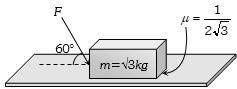
What is the maximum value of the force $F$ such that the block shown in the arrangement, does not move ........ $N$
Area under a speed $-$ time graph gives:
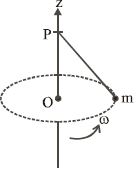
A small mass $m$ is attached to a massless string whose other end is fixed at $P$ as shown in figure. The mass is undergoing circular motion in $x-y$ plane with centre $O$ and constant angular speed $\omega $ . If the angular momentum of the system, calculated about $O$ and $P$ and denoted by $\vec L_o$ and $\vec L_p$ respectively, then