MCQ
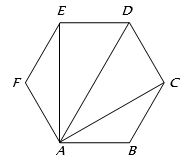
If $ ABCDEF$  is a regular hexagon and $\overrightarrow {AB} + \overrightarrow {AC} + \overrightarrow {AD} + \overrightarrow {AE} + \overrightarrow {AF} = \lambda \,\overrightarrow {AD} ,$ then $\lambda = $
  • A
    $2$
  • $3$
  • C
    $4$
  • D
    $6$

Answer

Correct option: B.
$3$
b
(b) By triangle law, $\overrightarrow {AB} = \overrightarrow {AD} - \overrightarrow {BD} ,$

$\overrightarrow {AC} = \overrightarrow {AD} - \overrightarrow {CD} $
Therefore, $\overrightarrow {AB} + \overrightarrow {AC} + \overrightarrow {AD} + \overrightarrow {AE} + \overrightarrow {AF} $

= $3\overrightarrow {AD} + (\overrightarrow {AE} - \overrightarrow {BD} ) + (\overrightarrow {AF} - \overrightarrow {CD} ) = 3\overrightarrow {AD} $

Hence $\lambda = 3$, [Since $\overrightarrow {AE} = \overrightarrow {BD,} \,\overrightarrow {AF} \, = \overrightarrow {CD} ]$.
Need a full question paper?

Generate a complete, print-ready paper with questions like this in minutes — across 16+ boards, with answer keys.

Start Generating Free

Similar questions

A variable line $\mathrm{L}$ passes through the point $(3,5)$ and intersects the positive coordinate axes at the points $\mathrm{A}$ and $\mathrm{B}$. The minimum area of the triangle $\mathrm{OAB}$, where $\mathrm{O}$ is the origin, is :
In the expansion of ${\left( {\frac{a}{x} + bx} \right)^{12}}$,the coefficient of $x^{-10}$ will be
If $z = x + iy$ and $|z - zi|\, = 1,$then
Consider a three-digit number with the following properties:

$I$. If its digits in units place and tens place are interchanged, the number increases by $36$ ;

$II.$ If its digits in units place and hundreds place are interchanged, the number decreases by $198 .$

Now, suppose that the digits in tens place and hundreds place are interchanged. Then, the number

If ${\rm{cosec }}A + \cot A = \frac{{11}}{2},$ then $\tan A = $
$\int_{}^{} {\frac{{dx}}{{(x + 1)(x + 2)}} = } $
Suppose $\theta \in\left[0, \frac{\pi}{4}\right]$ is a solution of $4 \cos \theta-3 \sin \theta=1$ Then $\cos \theta$ is equal to :
Let $a_1, a_2, a_3, a_4$ be real numbers such that $a_1+a_2+a_3+a_4=0$ and $a_1^2+a_2^2+a_3^2+a_4^2=1$. Then, the smallest possible value of the expression $\left(a_1-a_2\right)^2+\left(a_2-a_3\right)^2+\left(a_3-a_4\right)+\left(a_4-a_1\right)^2$ lies in the interval
The first term of an $A.P. $ is $2$ and common difference is $4$. The sum of its $40$ terms will be
We express $\frac{{{{(\cos 2\theta - i\sin 2\theta )}^4}{{(\cos 4\theta + i\sin 4\theta )}^{ - 5}}}}{{{{(\cos 3\theta + i\sin 3\theta )}^{ - 2}}{{(\cos 3\theta - i\sin 3\theta )}^{ - 9}}}}$ in the form of $x + iy$, we get