MCQ
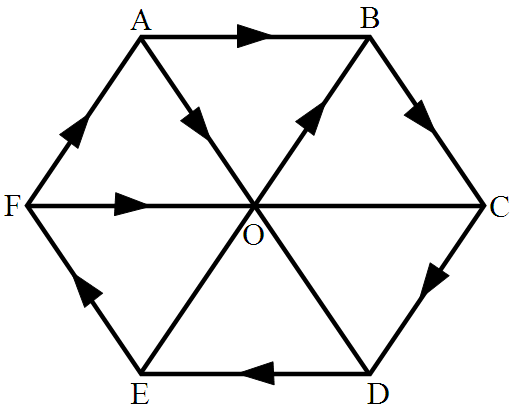
If ABCDEF is a regular hexagon, then $\overrightarrow{\text{AD}}+\overrightarrow{\text{EB}}+\overrightarrow{\text{FC}}$ equals,
  • A
    $2\overrightarrow{\text{AB}}$
  • B
    $\vec0$
  • C
    $3\overrightarrow{\text{AB}}$
  • $4\overrightarrow{\text{AB}}$

Answer

Correct option: D.
$4\overrightarrow{\text{AB}}$


$\overrightarrow{\text{AD}}=2\overrightarrow{\text{BC}}$

$\overrightarrow{\text{EB}}=2\overrightarrow{\text{FA}}$

$\overrightarrow{\text{FC}}=2\overrightarrow{\text{AB}}$

$\overrightarrow{\text{AD}}+\overrightarrow{\text{EB}}=2\Big(\overrightarrow{\text{BC}}+\overrightarrow{\text{FA}}\Big)$

$=2\Big(\overrightarrow{\text{AO}}+\overrightarrow{\text{FA}}\Big)$ $\Big(\because\ \overrightarrow{\text{BC}}=\overrightarrow{\text{AO}}\Big)$

In triangle AOF,

$\overrightarrow{\text{FA}}+\overrightarrow{\text{AO}}+\overrightarrow{\text{FO}}=0$

$\therefore\ \overrightarrow{\text{FA}}+\overrightarrow{\text{AO}}=-\overrightarrow{\text{FO}}$

$\therefore\overrightarrow{\text{AD}}+\overrightarrow{\text{EB}}=-2\overrightarrow{\text{FO}}$

And $\overrightarrow{\text{AB}}=-\overrightarrow{\text{FO}}$

$\therefore\overrightarrow{\text{AD}}+\overrightarrow{\text{EB}}=2\overrightarrow{\text{AB}}$

$\therefore\overrightarrow{\text{AD}}+\overrightarrow{\text{EB}}+\overrightarrow{\text{FC}}=2\overrightarrow{\text{AB}}+2\overrightarrow{\text{AB}}$

$=4\overrightarrow{\text{AB}}$

Need a full question paper?

Generate a complete, print-ready paper with questions like this in minutes — across 16+ boards, with answer keys.

Start Generating Free

Similar questions

If $|\vec{\text{a}}|=\big|\vec{\text{b}}\big|,$ then $\big(\vec{\text{a}}+\vec{\text{b}}\big).\big(\vec{\text{a}}-\vec{\text{b}}\big)=$
Let  $a, b,c $ be three vectors from ,  $a\times (b\times c)=(a\times b)\times c$ if 
Choose the correct answers from the given four options:
The set of points where the function f given by $\text{f(x)}=|2\text{x}-1|\sin\text{x}$ is differentiable is:
The solution of the differential equation $x\cos ydy = (x{e^x}\log x + {e^x})dx$ is
Give the correct order of initials $T$ or $F$ for following statements. Use $T$ if statement is true and $F$ if it is false.
Statement $-1$ : If $A$ is an invertible $3 × 3$ matrix and $B$ is a $3 × 4$ matrix, then $A^{-1}B$ is defined
Statement $-2$ : It is never true that $A + B, A - B$, and $AB$ are all defined.
Statement $-3$ : Every matrix none of whose entries are zero is invertible.
Statement $-4$ : Every invertible matrix is square and has no two rows the same.
$\int\frac{\text{e}^{\text{x}}(1+\text{x})}{\cos^2(\text{x}\text{e}^{\text{x}})}\text{ dx}=$
Let $g(x)=3 f\left(\frac{x}{3}\right)+f(3-x)$ and $f^{\prime \prime}(x)>0$ for all $\mathrm{x} \in(0,3)$. If $\mathrm{g}$ is decreasing in $(0, \alpha)$ and increasing in $(\alpha, 3)$, then $8 \alpha$ is
The number of points at which the function $f(x) = |x - 0.5| + |x - 1| + \tan x$ does not have a derivative in the interval $(0, 2),$ is
If $y = f(x) = \frac{{ax + b}}{{cx - a}}$, then $x$ is equal to
Solve $\int\frac{1}{\sqrt{9-25\text{x}^2}}\text{dx}$