If all the resistors shown have the value $2\, ohm$ each, the equivalent resistance over $AB$ is
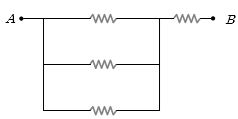
Easy


Download our appand get started for free
Experience the future of education. Simply download our apps or reach out to us for more information. Let's shape the future of learning together!No signup needed.*
Similar Questions
- 1Carbon resistor has resistance specified by three bands having colour red, yellow and black. If this resistor is cut into two pieces of equal length then the new colour code of each one will be (Neglect tolerance of $4^{th}$ band)View Solution
- 2Find the equivalent resistance across $AB$ .............. $\Omega$View Solution
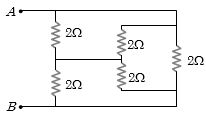
- 3A piece of copper and another of germanium are cooled from room temperature to $80\, K$. The resistance of :-View Solution
- 4Fig. shows rough sketch of meter bridge. $(G)$ deflects zero at length $l\, cm$. Now $R_1$ and $R_2$ are interchanged then balancing length increases by $25\, cm$. Find $R_1/R_2$View Solution
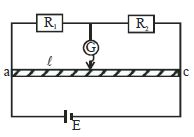
- 5View SolutionIn given circuit
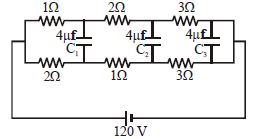
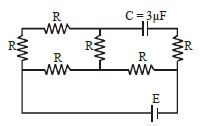
- 6In steady state the potential difference across the capacitor is $10\,\, V.$ Each resistance is of $3\,\Omega $. The cell is ideal. The $emf$ of the cell is .............. $\mathrm{V}$View Solution
- 7Two electric bulbs whose resistance are in the ratio of $1: 2$, are connected in parallel to a constant voltage source. The power dissipated in them has the ratioView Solution
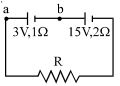
- 8Two batteries one of the $\mathrm{emf}$ $3\,V$, internal resistance $1$ ohm and the other of $\mathrm{emf}$ $15\, V$, internal resistance $2$ $\mathrm{ohm}$ are connected in series with a resistance $R$ as shown. If the potential difference between $a$ and $b$ is zero the resistance of $R$ in $\mathrm{ohm}$ isView Solution
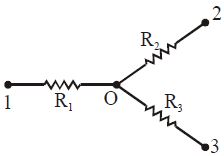
- 9.............. $A$ the current flowing through the resistance $R_2$ of the circuit shown in fig if the resistance are equal to $R_1 = 20\ \Omega, R_2 = 30 \ \Omega$ and $R_3 = 60 \ \Omega$ and potentials of points $1, 2$ and $3$ are equal to $V_1= 20\, V,$ $V_2 = 30\ V$ and $V_3 = 60\ V$View Solution
- 10View SolutionIf the length of potentiometer wire is increased, then the length of the previously obtained balance point will