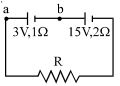
Two batteries one of the $\mathrm{emf}$ $3\,V$, internal resistance $1$ ohm and the other of $\mathrm{emf}$ $15\, V$, internal resistance $2$ $\mathrm{ohm}$ are connected in series with a resistance $R$ as shown. If the potential difference between $a$ and $b$ is zero the resistance of $R$ in $\mathrm{ohm}$ is
Medium


Download our appand get started for free
Experience the future of education. Simply download our apps or reach out to us for more information. Let's shape the future of learning together!No signup needed.*
Similar Questions
- 1A thermocouple of negligible resistance produces an $e.m.f.$ of $40\,\mu V{/^o}C$ in the linear range of temperature. A galvanometer of resistance $10\; ohm$ whose sensitivity is $1\;\mu A/div$, is employed with the thermocouple. The smallest value of temperature difference that can be detected by the system will beView Solution
- 2View SolutionThe colour sequence in a carbon resistor is red, brown, orange and silver. The resistance of the resistor is
- 3Three copper wires of lengths and cross sectional areas are $(l,\,A),\,(2l,\,A/2)$ and $(l/2,\, 2A)$ . Resistance is minimum inView Solution
- 4Find out current in $3\,\Omega $ resistance in given circuitView Solution
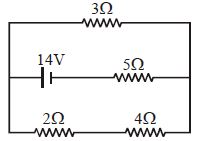
- 5If power in $3\,\Omega $ is $27\,W$ then what is the power in $2\,\Omega $ ................ $\mathrm{W}$View Solution
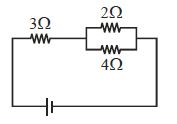
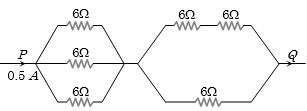
- 6Resistances of $6\, ohm$ each are connected in the manner shown in adjoining figure. With the current $0.5\,ampere$ as shown in figure, the potential difference ${V_P} - {V_Q}$ is .............. $V$View Solution
- 7Four identical cells each having an electromotive force $(e.m.f.)$ of $12\,V$, are connected in parallel. The resultant electromotive force $(e.m.f.)$ of the combination is .............. $V$View Solution
- 8An electric wire of length ‘$I$’ and area of cross-section $a$ has a resistance $R\, ohms$. Another wire of the same material having same length and area of cross-section $4a$ has a resistance ofView Solution
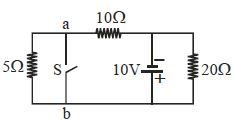
- 9In the circuit shown below, the current that flows from $a$ to $b$ when the switch $S$ is closed ............... $A$View Solution
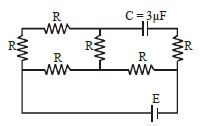
- 10In steady state the potential difference across the capacitor is $10\,\, V.$ Each resistance is of $3\,\Omega $. The cell is ideal. The $emf$ of the cell is .............. $\mathrm{V}$View Solution