Question
If an automobile engine is overheated, it is cooled by putting water on it. It is advised that the water should be put slowly with engine running. Explain the reason.

Answer

In a hot engine the hot parts are expanded because of heat, if cold water is poured suddenly then there will be uneven thermal contraction in the parts. This will result in a stress to develop between the various parts of the engine and may let the engine to crack down.

Need a full question paper?

Generate a complete, print-ready paper with questions like this in minutes — across 16+ boards, with answer keys.
Start Generating Free

Similar questions

Out of the two magnetic materials, 'A' has relative permeability slightly greater than unity while 'B' has less than unity. Identify the nature of the materials 'A' and 'B'. Will their susceptibilities be positive or negative?
Electrons oscillating in a circuit give rise to radiowaves. $A$ transmitting antenna radiates most effectively the radiowaves of wavelength equal to the size of the antenna. The infrared waves incident on a substance set into oscillation all its electrons, atoms and molecules. This increases the internal energy and hence the temperature of the substance.
  1. If $v_g, v_x$ and $v_m$ are the speeds of gamma rays, $X-$rays and microwaves respectively in vacuum, the
  1. $v_g > v_x > v_m$
  2. $v_g < v_x < v_m$
  3. $v_g > v_x > v_m$
  4. $v_g = v_x = v_m​​​​​​​$
  1. Which of the following wi $II$ deflect in electric field?
  1. $X-$rays.
  2. $\gamma-\text{rays}.$
  3. Cathode rays.
  4. Ultraviolet rays.
  1. $\gamma-\text{rays}$ are detected by:
  1. Point contact diodes.
  2. Thennopiles.
  3. Ionization chamber.
  4. Photocells.
  1. The frequency of electromagnetic wave, which best suited to observe a particle ofradius $3 \times 10^{-4}cm$ is the order of,
  1. $10^{15}Hz$
  2. $10^{14} Hz$
  3. $10^{13}Hz$
  4. $10^{12}Hz$
  1. We consider the radiation emitted by the human body. Which one of the following statements is true?
  1. The radiation emitted is in the infrared region.
  2. The radiation is emitted only during the day.
  3. The radiation is emitted during the summers and absorbed during the winters.
  4. The radiation emitted lies in the ultraviolet region and hence it is not visible.
An electric dipole of length 2 cm is placed in an electric field of intensity $10^5$ Newton/Coulomb in such a way that its axis makes an angle of $30^{\circ}$ with the direction of the field. A torque of $10 \sqrt{3}$ Newton meter acts on it. Find the magnitude of charge on the electric diple.
Find the change in the volume of $1.0$ litre kerosene when it is subjected to an extra pressure of $2.0 \times 10^5N/m^2$ from the following data. Density of kerosene $= 800\ kg/m^3$ and speed of sound in kerosene $= 1330m/s.$
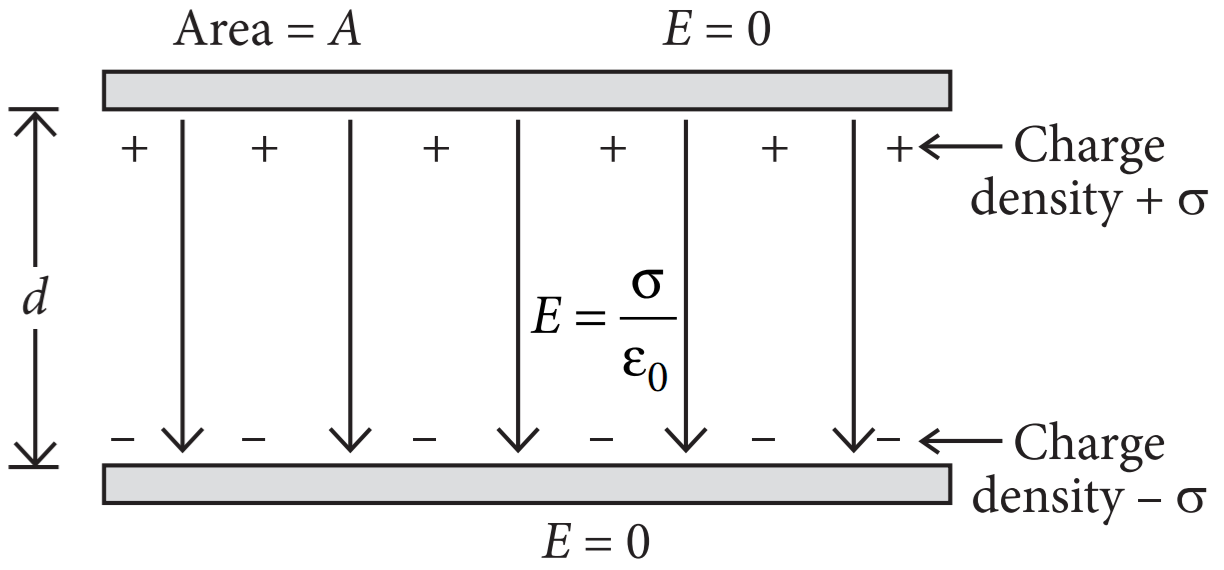
The simplest and the most widely used capacitor is the parallel plate capacitor. It consists of two large plane parallel conducting plates, separated by a small distance. In the outer regions above the upper plate and below the lower plate, the electric fields due to the two charged plates cancel out. The net field is zero. In the inner region between the two capacitor plates, the electric fields due to the two charged plates add up. The net field is $\frac{\sigma}{\epsilon_0}.$
For a uniform electric field, potential difference between the plates $=$ Electric field x distance between the plates. Capacitance of the parallel plate capacitor is the charge required to supplied to either of the conductors of the capacitor so as to increase the potential difference between then by unit amount.
  1. A parallel plate capacitor is charged and then isolated. The effect of increasing the plate separation on charge, potential and capacitance respectively are:
  1. Increases, decreases, decreases.
  2. Constant, increases, decreases.
  3. Constant, decreases, decreases.
  4. Constant, decreases, increases.
  1. In a parallel plate capacitor, the capacity increases if:
  1. Area of the plate is decreases.
  2. Distance between the plates increases.
  3. Area of the plate is increases.
  4. Dielectric constant decreases.
  1. A parallel plate capacitor has two square plates with equal and opposite charges. The surface charge densities on the plates are $+\sigma$ and $-\sigma$ respectively. In the region between the plates the magnitude of the electric field is:
  1. $\frac{\sigma}{2\epsilon_0}$
  2. $\frac{\sigma}{\epsilon_0}$
  3. $0$
  4. None of these.
  1. If a parallel plate air capacitor consists of two circular plates of diameter $8\ cm$. At what distance should the plates be held so as to have the same capacitance as that of sphere of diameter $20\ cm$?
  1. $9\ mm$
  2. $4\ mm$
  3. $8\ mm$
  4. $2\ mm$
  1. If a charge of $+ 2.0 \times 10^{-8}C$ is placed on the positive plate and a charge of $- 1.0 \times 10^{-8}C$ on the negative plate of a parallel plate capacitor of capacitance $1.2\times10^{-3}\mu\text{F},$ then the potential difference developed between the plates is:
  1. $6.25V$
  2. $3.0V$
  3. $12.5V$
  4. $25V$
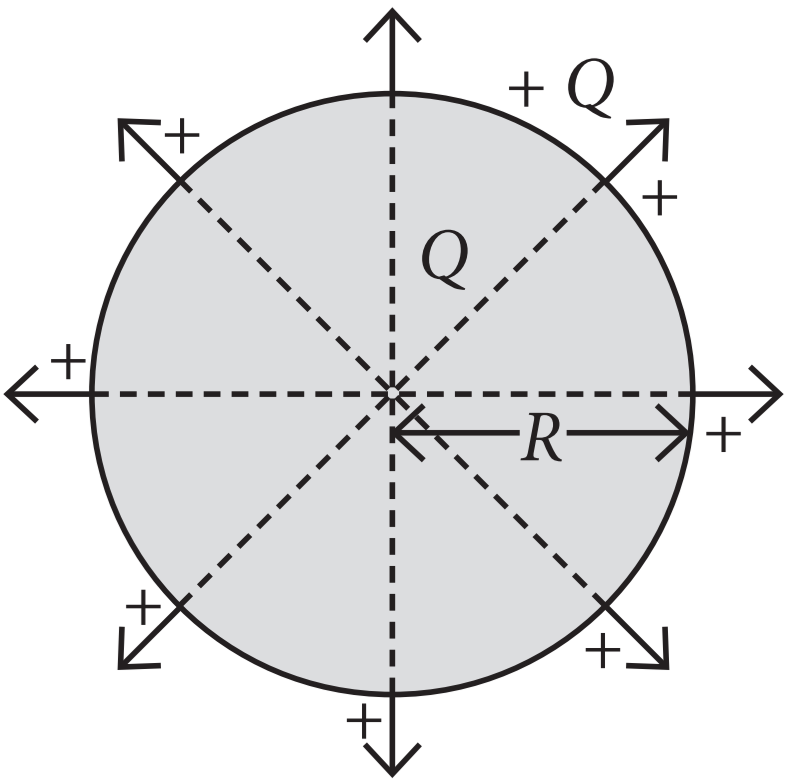
The electrical capacitance of a conductor is the measure of its ability to hold electric charge. An isolated spherical conductor of radius $R$. The charge $Q$ is uniformly distributed over its entire surface. It can be assumed to be concentrated at the centre of the sphere. The potential at any point on the surface of the spherical conductor will be $\text{V}=\frac{1}{4\pi\epsilon_0}\frac{\text{Q}}{\text{R}}.$
Capacitance of the spherical conductor situated in vacuum is $\text{C}=\frac{\text{Q}}{\text{V}}=\frac{\text{Q}}{\frac{1}{4\pi\epsilon_0}.\frac{\text{Q}}{\text{R}}}$ or $\text{C}=4\pi\epsilon_0\text{R}$ Clearly, the capacitance of a spherical conductor is proportional to its radius.
The radius of the spherical conductor of $1F$ capacitance is $\text{R}=\frac{1}{4\pi\epsilon_0}. C$ and this radius is about $1500$ times the radius of the earth $(\sim6\times10^3\text{km}).$
  1. If an isolated sphere has a capacitance $50pE$ Then radius is:
  1. $90\ cm$
  2. $45\ cm$
  3. $45m$
  4. $90m$
How much charge should be placed on a capacitance of $25 pF$ to raise its potential to $105V$?
  1. $1\mu\text{C}$
  2. $1.5\mu\text{C}$
  3. $2\mu\text{C}$
  4. $2.5\mu\text{C}$
Dimensions of capacitance is:
  1. $[M L^{-2} T^4 A^2]$
  2. $[M^{-1} L^{-1} T^3 A^1]$
  3. $[M^{- }L^{-2} T^4 A^2]$
  4. $[M^0 L^{-2} T^4 A^1]$
Metallic sphere of radius $R$ is charged to potential $V$. Then charge $q$ is proportional to:
  1. $V$
  2. $R$
  3. Both $V$ and $R$
  4. None of these
If $64$ identical spheres of charge $q $ and capacitance $C$ each are combined to form a large sphere. The charge and capacitance of the large sphere is:
  1. $64q, C$
  2. $16q, 4C$
  3. $64q, 4C$
  4. $16q, 64C$
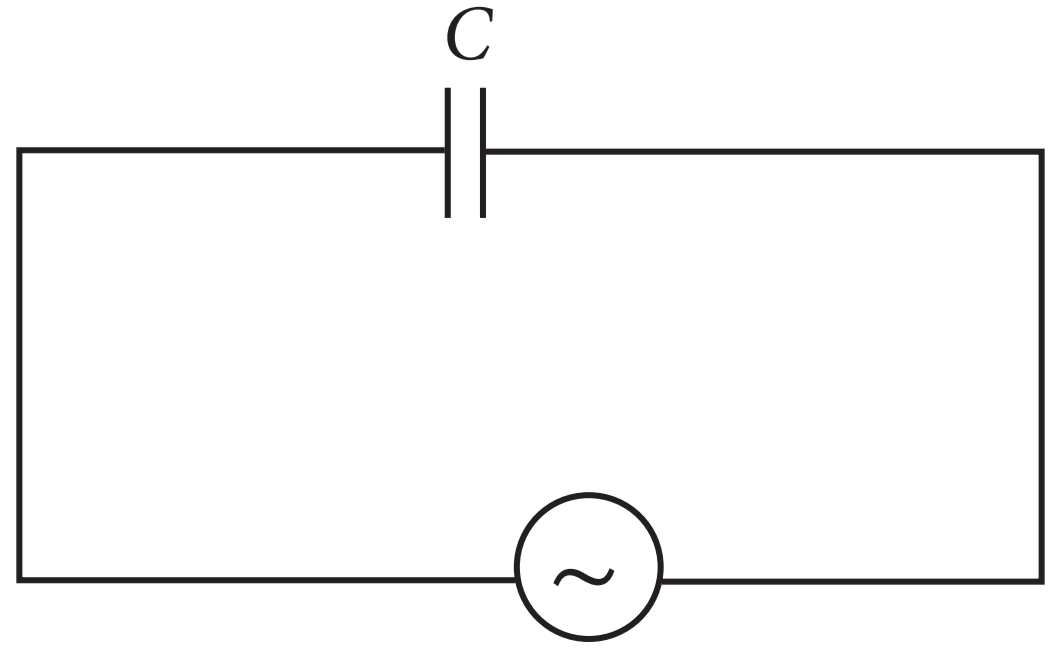
Let a source of alternating $e.m.f. \text{E} = \text{E}_\circ\sin\omega\text{t}$ be connected to a capacitor of capacitance $C.$ If $'I\ '$ is the instantaneous value of current in the circuit at instant $t,$ then $\text{I}=\frac{\text{E}_0}{\frac{1}{\omega\text{C}}}\sin\Big(\omega\text{t}+\frac{\pi}{2}\Big).$ The capacitive reactance limits the amplitude of current in a purely capacitive circuit and it is given by $\text{X}_\text{C}=\frac{1}{\omega\text{C}}.$
  1. What is the unit of capacitive reactance?
  1. Farad
  2. Ampere
  3. $\ce{Ohm}$
  4. $\ce{Ohm^{-1}}$
  1. The capacitive reactance of a $5\mu\text{F}$ capacitor for a frequency of $10^6\ \ce{Hz}$ is:
  1. $0.032\Omega$
  2. $2.52\Omega$
  3. $1.25\Omega$
  4. $4.51\Omega$
  1. In a capacitive circuit, resistance to the flow of current is offered by:
  1. Resistor
  2. Capacitor
  3. Inducto
  4. Frequency
  1. In a capacitive circuit, by what value of phase angle does alternating current leads the $e.m.f$?
  1. $45^\circ$
  2. $90^\circ$
  3. $75^\circ$
  4. $60^\circ$
  1. One microfarad capacitor is joined to a $200V, 5 \ \ce{Hz}$ alternator. The rrns current through capacitor is:
  1. $6.28 \times 10^{-2}A$
  2. $7.5 \times 10^{-4}A$
  3. $10.52 \times 10^{-2}A$
  4. $15.25 \times 10^{-2}A$
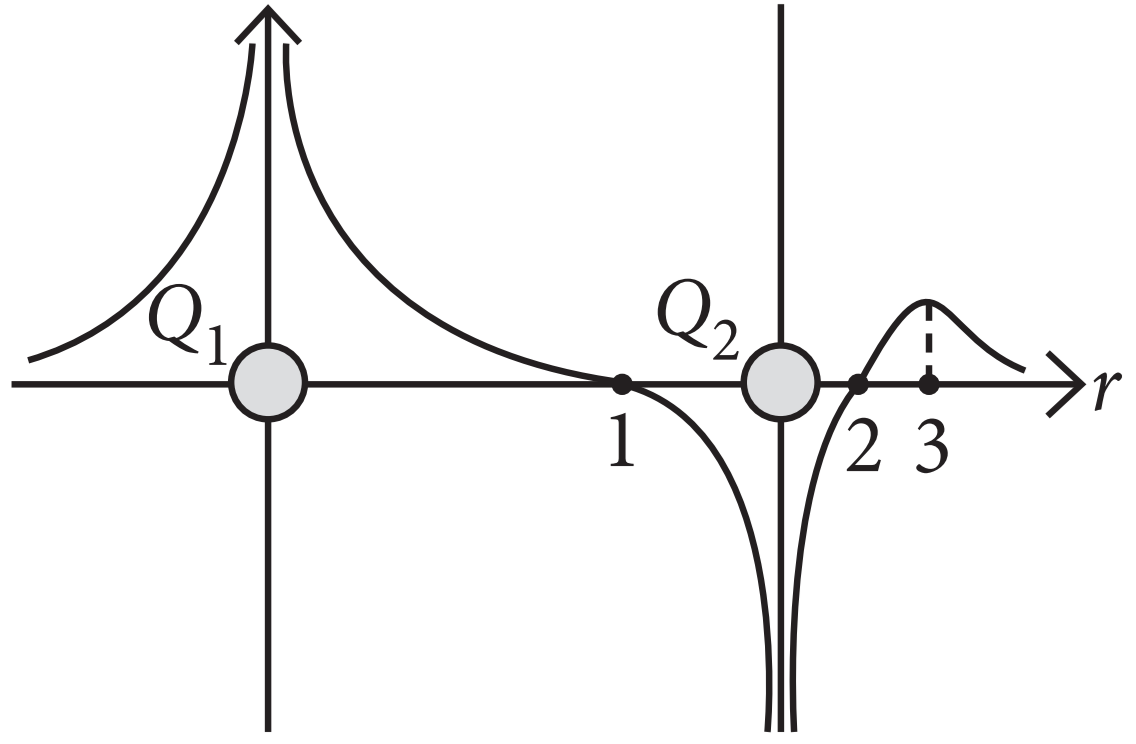
The potential at any observation point $P$ of a static electric field is defined as the work done by the external agent $($or negative of work done by electrostatic field$)$ in slowly bringing a unit positive point charge from infinity to the observation point. Figure shows the potential variation along the line of charges. Two point charges $Q_1 $ and $Q_2$ lie along a line at a distance from each other.
  1. At which of the points $1, 2,$ and $3$ is the electric field is zero?
  1. $1$
  2. $2$
  3. $3$
  4. Both $(a)$ and $(b)$
The work done by the electric field when another positive point charge is moved from
  1. $(-a, 0, 0)$ to $(0, a, 0)$ 
  2. Positive.
  3. Negative.
  4. Zero.
Depends on the path connecting the initial and final positions.Positive and negative point charges of equal magnitude are kept at $\Big(0,0,\frac{\text{a}}{2}\Big)$ and $\Big(0,0,\frac{\text{-a}}{2}\Big)$ respectively.
  1. Electrostatic force is a conservative force.
  2. Potential energy of charge $q$ at a point is the work done per unit charge in bringing a charge from any point to infinity.
  3. When two like charges lie infinite distance apart, their potential energy is zero.
  4. Both $(a) $ and $(c).$
Which of the following statement is not true?
  1. $Q_2$
  2. $Q_1$
  3. Same.
  4. Can't determined.
Which of the two charges $Q_1$ and $Q_2 $ is greater in magnitude?
  1. Positive and negative.
  2. Negative and positive.
  3. Positive and positive.
  4. Negative and negative.
The signs of charges $Q_1$ and $Q_2$ respectively are:
A police jeep is chasing a culprit going on a motorbike. The motorbike crosses a turning at a speed of $72\ km/h.$ The jeep follows it at a speed of $90\ km/h,$ crossing the turning ten seconds later than the bike. Assuming that they travel at constant speeds, how far from the turning will the jeep catch up with the bike?
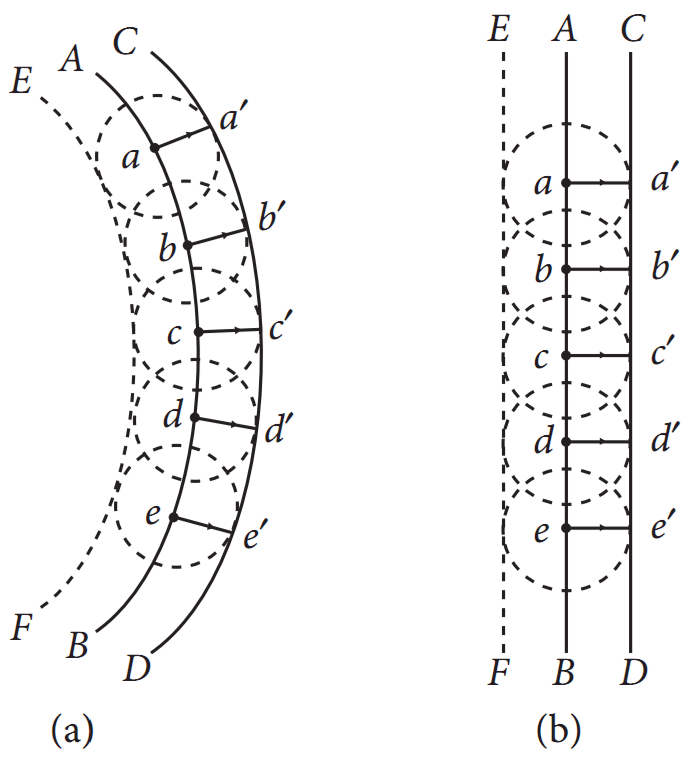
Huygen's principle is the basis of wave theory of light. Each point on a wavefront acts as a fresh source of new disturbance, called secondary waves or wavelets. The secondary wavelets spread out in all directions with the speed light in the given medium.
An initially parallel cylindrical beam travels in a medium of refractive index $\mu(\text{I})=\mu_0+\mu_2\text{I}$, where $\mu_0$ and $\mu_2$ are positive constants and I is the intensity of the light beam. The intensity of the beam is decreasing with increasing radius.
  1. The initial shape of the wavefront of the beam is:
  1. Planar.
  2. Convex.
  3. Concave.
  4. Convex near the axis and concave near the periphery.
  1. According to Huygens Principle, the surface of constant phase is:
  1. Called an optical ray.
  2. Called a wave.
  3. Called a wavefront.
  4. Always linear in shape.
  1. As the beam enters the medium, it will:
  1. Travel as a cylindrical beam.
  2. Diverge.
  3. Converge.
  4. Diverge near the axis and converge near the periphery.
  1. Two plane wavefronts oflight, one incident on a thin convex lens and another on the refracting face of a thin prism. After refraction at them, the emerging wavefronts respectively become.
  1. Plane wavefront and plane wavefront.
  2. Plane wavefront and spherical wavefront.
  3. Spherical wavefront and plane wavefront.
  4. Spherical wavefront and spherical wavefront.
  1. Which of the following phenomena support the wave theory of light?
  1. Scattering.
  2. Interference.
  3. Diffraction.
  4. Velocity of light in a denser medium is less than the velocity of light in the rarer medium.
  1. 1, 2, 3
  2. 1, 2, 4
  3. 2, 3, 4
  4. 1, 3, 4