Question
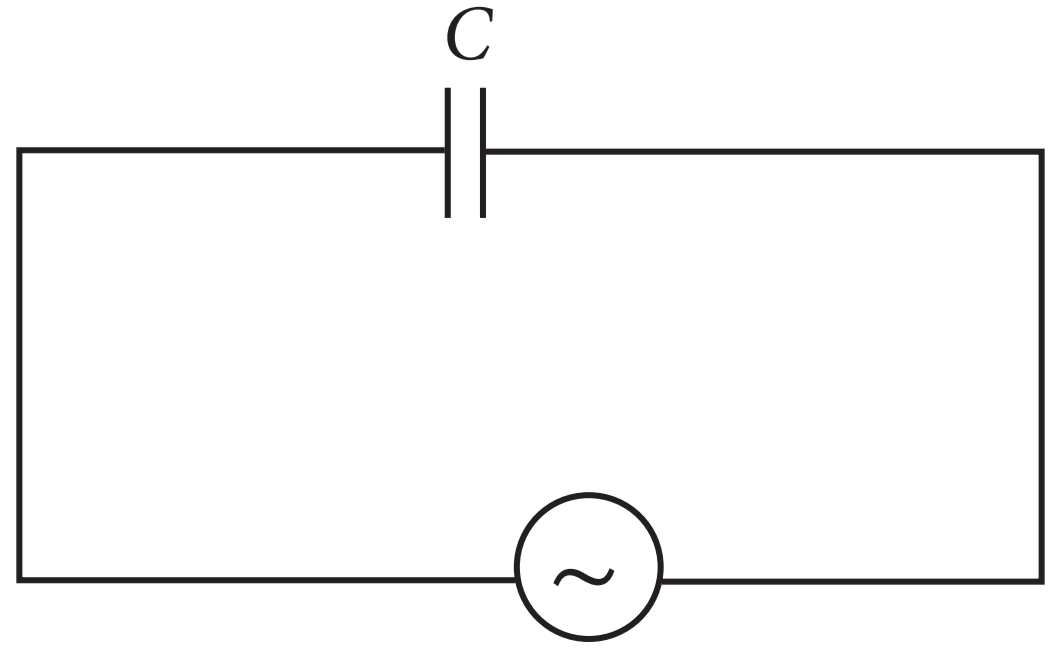
Let a source of alternating $e.m.f. \text{E} = \text{E}_\circ\sin\omega\text{t}$ be connected to a capacitor of capacitance $C.$ If $'I\ '$ is the instantaneous value of current in the circuit at instant $t,$ then $\text{I}=\frac{\text{E}_0}{\frac{1}{\omega\text{C}}}\sin\Big(\omega\text{t}+\frac{\pi}{2}\Big).$ The capacitive reactance limits the amplitude of current in a purely capacitive circuit and it is given by $\text{X}_\text{C}=\frac{1}{\omega\text{C}}.$
  1. What is the unit of capacitive reactance?
  1. Farad
  2. Ampere
  3. $\ce{Ohm}$
  4. $\ce{Ohm^{-1}}$
  1. The capacitive reactance of a $5\mu\text{F}$ capacitor for a frequency of $10^6\ \ce{Hz}$ is:
  1. $0.032\Omega$
  2. $2.52\Omega$
  3. $1.25\Omega$
  4. $4.51\Omega$
  1. In a capacitive circuit, resistance to the flow of current is offered by:
  1. Resistor
  2. Capacitor
  3. Inducto
  4. Frequency
  1. In a capacitive circuit, by what value of phase angle does alternating current leads the $e.m.f$?
  1. $45^\circ$
  2. $90^\circ$
  3. $75^\circ$
  4. $60^\circ$
  1. One microfarad capacitor is joined to a $200V, 5 \ \ce{Hz}$ alternator. The rrns current through capacitor is:
  1. $6.28 \times 10^{-2}A$
  2. $7.5 \times 10^{-4}A$
  3. $10.52 \times 10^{-2}A$
  4. $15.25 \times 10^{-2}A$

Answer

  1. $(c) \ \ce{Ohm}$
Ohm is the unit of capacitive reactance.
  1. $(a) \ 0.032\Omega$
Capacitive reactance, $\text{X}_\text{C}=\frac{1}{\omega\text{C}}=\frac{1}{2\pi\mu\text{C}}$
$=\frac{1}{2\pi\times10^6\times5\times10^{-6}}$
$=0.032\Omega$
  1. $(b)$ Capacitor
In capacitive circuit, resistance to the flow of current is offered by the capacitor.
  1. $(b) 90^\circ$
  2. $(a) 6.28 \times 10^{-2}A$
Current, $\text{l}_\text{v}=\frac{\text{E}_\text{V}}{\text{X}_\text{C}}=\frac{1}{\frac{1}{2\pi\mu\text{C}}}=(2\pi\mu\text{C})\text{E}_\text{V}$
$\text{I}_\text{v}=2\times3.14\times50\times10^{-6}\times200$
$=6.28 × 10^{-2}\text{A}$

Need a full question paper?

Generate a complete, print-ready paper with questions like this in minutes — across 16+ boards, with answer keys.

Start Generating Free

Similar questions

Suppose the density of air at Madras is $P_0$ and atomospheric pressure is $P_0.$ If we go up, the density and the pressure both decrease. Suppose we wish to calculate the pressure at a height $10\ km$ above Madras. If we use the equation $P_{0 }- P = pogz,$ will we get a pressure more than the actual or less than the actual? Neglect the variation in $g.$ Does your answer change if you also consider the variation in $g$?

The field of a hollow wire with constant current is homageneous.
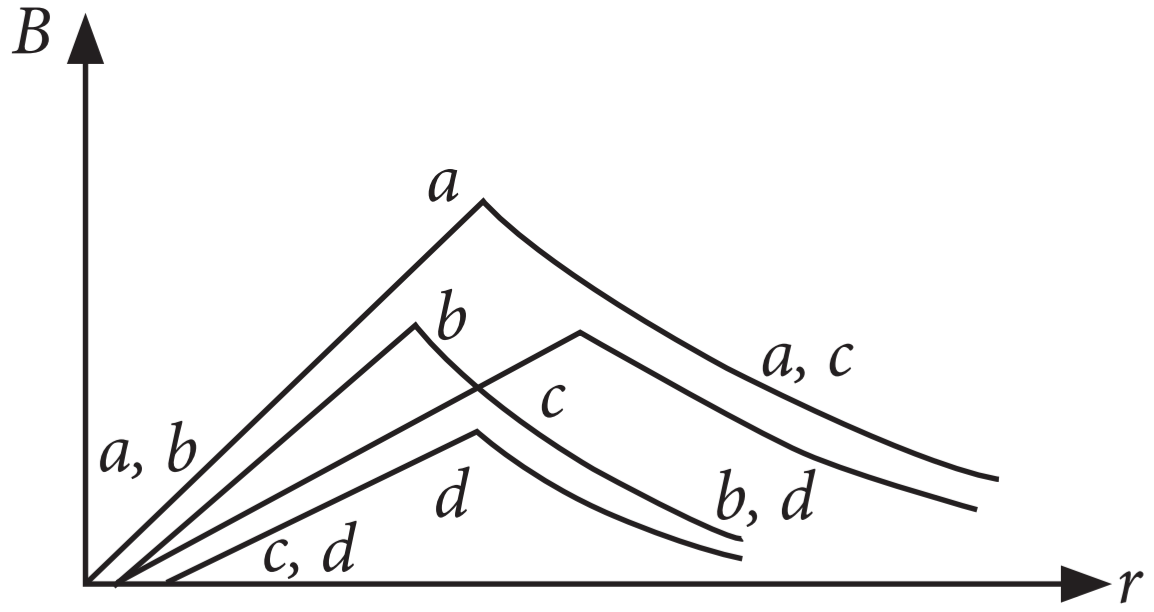
Curves in the graph shown give, as functions of radius distance r, the magnitude B of the magnetic field inside and outside four long wires a, b, c and d, carrying currents that are uniformly distributed across the cross sections of the wires. Overlapping portions of the plots are indicated by double labels.
  1. Which wire has the greatest magnitude of the magnetic field on the surface?
  1. a
  2. b
  3. c
  4. d
  1. The current density in a wire a is:
  1. Greater than in wire c.
  2. Less than in wire c.
  3. Equal to that in wire c.
  4. Not comparable to that of in wire c due to lack of information.
  1. Which wire has the greatest radius?
  1. a
  2. b
  3. c
  4. d
  1. A direct current I flows along the length of an infinitely long straight thin walled pipe, then the magnetic field is:
  1. Uniform throughout the pipe but not zero.
  2. Zero only along the axis of the pipe.
  3. Zero at any point inside the pipe.
  4. Maximum at the centre and minimum at the edges.
  1. In a coaxial, straight cable, the central conductor and the outer conductor carry equal currents in opposite direction. The magnetic field is zero.
  1. Outside the cable.
  2. Inside the inner conductor.
  3. Inside the outer conductor.
  4. In between the two conductor.
Electrons oscillating in a circuit give rise to radiowaves. A transmitting antenna radiates most effectively the radiowaves of wavelength equal to the size of the antenna. The infrared waves incident on a substance set into oscillation all its electrons, atoms and molecules. This increases the internal energy and hence the temperature of the substance.

(i) If $v_g, v_X$ and $v_m$ are the speeds of gamma rays, $X$-rays and microwaves respectively in vacuum, then
(a) $v_g>v_X>v_m$
(b) $v_g<v_X<v_m$
(c) $v_g>v_X>v_m$
(d) $v_g=v_X=v_m$

(ii) Which of the following will deflect in electric field?
(a) ultraviolet rays
(b) $\gamma$-rays
(c) X-rays
(d) cathode rays

(iii) $\gamma$-rays are detected by
(a) point contact diodes
(c) thermopiles
(b) ionization chamber
(d) photocells

OR

We consider the radiation emitted by the human body. Which one of the following statements is true?
i. The radiation emitted is in the infrared region
ii. The radiation is emitted only during the day.
iii. The radiation is emitted during the summers and absorbed during the winters.
iv. The radiation emitted lies in the ultraviolet region and hence it is not visible
(a) Option(iv) (iii) (b) Option (ii) (c) Option (d) Option (i)

(iv) The frequency of electromagnetic wave, which best suited to observe a particle of radius $3 \times 10^{-4} cm$ is the order of
(a) $10^{14} Hz$
(b) $10^{12} Hz$
(c) $10^{13} Hz$
(d) $10^{15} Hz$
A narrow pencil of parallel light is incident normally on a solid transparent sphere of radius $r$. What should be the refractive index if the pencil is to he focused.
  1. At the surface of the sphere.
  2. At the centre of the sphere.
A small object is embedded in a glass sphere $(\mu=1.5)$ of radius 5.0cm at a distance 1.5cm left to the centre. Locate the image of the object as seen by an observer standing.
  1. To the left of the sphere.
  2. To the right of the sphere.
Two cations with equal charge repel each other with a force of $3.7 \times 10^{-9}$ Newton while the distance between them is $5 A$. How many electrons are less in each ion than in the normal state?
What is the de-Broglie wavelength of
(a) A bullet of mass 0.040 kg travelling at the speed of 1.0 km/s,
(b) A ball of mass 0.060 kg moving a t a speed of 1.0 m/s, and
(c) A dust particle of mass $1.0 \times 10^{-9}$ with a speed of 2.2 m/s?
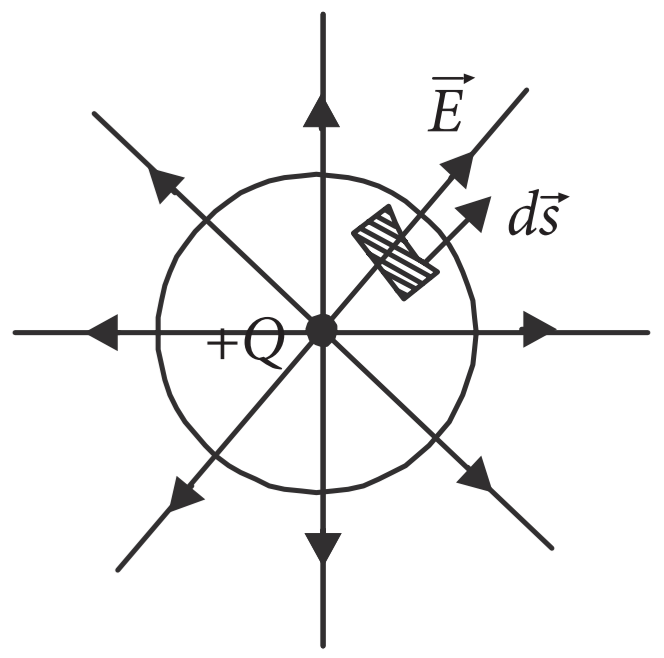
Gauss's law and Coulomb's law, although expressed in different forms, are equivalent ways of describing the relation between charge and electric field in static conditions. Gauss's law is $\epsilon_0\phi=\text{q}_{\text{end},}$ when $\text{q}_{\text{encl}}$ is the net charge inside an imaginary closed surface called Gaussian surface. $\phi=\oint\vec{\text{E}}\cdot\text{d}\vec{\text{A}}$ gives the electric flux through the Gaussian surface. The two equations hold only when the net charge is in vacuum or air.
  1. If there is only one type of charge in the universe, then $(\vec{\text{E}}\rightarrow$ Electric field, $\text{d}\vec{\text{s}}\rightarrow$ Area vector$)$.
  1. $\oint\vec{\text{E}}\cdot\text{d}\vec{\text{s}}\not=0$ on any surface.
  2. $\oint\vec{\text{E}}\cdot\text{d}\vec{\text{s}}$ could not be defined.
  3. $\oint\vec{\text{E}}\cdot\text{d}\vec{\text{s}}=\infty$ if charge is inside.
  4. $\oint\vec{\text{E}}\cdot\text{d}\vec{\text{s}}=0$ if charge is outside, $\oint\vec{\text{E}}\cdot\text{d}\vec{\text{s}}=\frac{\text{q}}{\epsilon_0}$ if charge is inside.
  1. What is the nature of Gaussian surface involved in Gauss law of electrostatic?
  1. Magnetic.
  2. Scalar.
  3. Vector.
  4. Electrical.
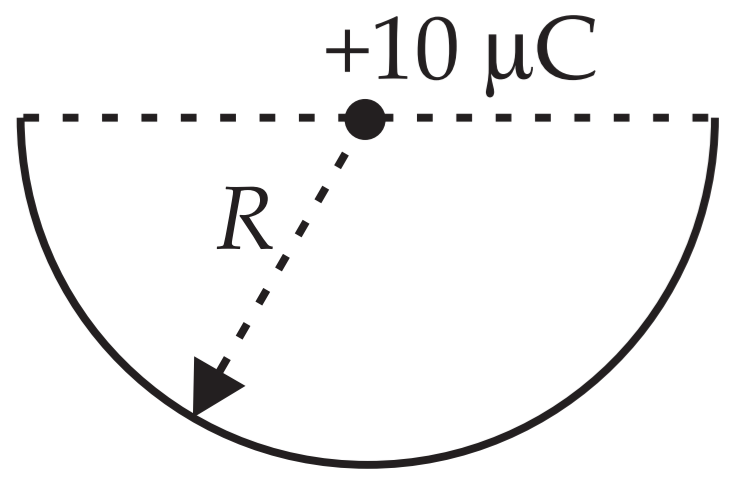
  1. A charge $10\mu\text{C}$ is placed at the centre of a hemisphere of radius $R = 10\ cm$ as shown. The electric flux through the hemisphere $($in $\text{MKS}$ units$)$ is:
  1. $20 \times 10^5$
  2. $10 \times 10^5$
  3. $6 \times 10^5$
  4. $2 \times 10^5$
  1. The electric flux through a closed surface area $S$ enclosing charge $Q$ is $\phi$. If the surface area is doubled, then the flux is:
  1. $2\phi$
  2. $\frac{\phi}{2}$
  3. $\frac{\phi}{4}$
  4. $\phi$
  1. A Gaussian surface encloses a dipole. The electric flux through this surface is:
  1. $\frac{\text{q}}{\epsilon_0}$
  2. $\frac{\text{2q}}{\epsilon_0}$
  3. $\frac{\text{q}}{2\epsilon_0}$
  4. Zero
In a microwave oven, the food is kept in a plastic container and the microwave is directed towards the food. The food is cooked without melting or igniting the plastic container. Explain.
A silver ball of radius $4.8\ cm$ is suspended by a thread in a vacuum chamber. Ultraviolet light of wavelength $200$ run is incident on the ball for some time during which a total light energy of $1.0 \times 10^{-7}J$ falls on the surface. Assuming that on the average one photon out of every ten thousand is able to eject a photoelectron, find the electric potential et the surface of the bell assuming zero potential at infinity. What is the potential at the centre of the bell?