MCQ
If an average person jogs, he produces $14.5 \times 103\ \text{cal/ min.}$ This is removed by the evaporation of sweat. The amount of sweat evaporated per minute $($assuming $1\ kg$ requires $580 \times 103\ \text{cal}$ for evaparation$)$ is
  • $0.25\ kg$
  • B
    $2.25\ kg$
  • C
    $0.05\ kg$
  • D
    $0.20\ kg$

Answer

Correct option: A.
$0.25\ kg$
$580 \times 10^3$ Calories are needed to convert $1\ \ce{kg H_2O}$ into steam.
$1\ \text{cal}$ will producer sweat $=\frac{1}{580\times10^{3}}$
$14.5 \times 10^3\ \text{cal}$ will producer sweat $=\frac{14.5\times10^3}{580\times10^3}$
$=\frac{145}{5800}\text{kg }$ Perminute
$=0.25\text{kg }$ Perminute

Need a full question paper?

Generate a complete, print-ready paper with questions like this in minutes — across 16+ boards, with answer keys.

Start Generating Free

Similar questions

A body of mass $m_1$ moving with an unknown velocity of $v_1 \hat i$ undergoes a collinear collision with a body of mass $m_2$ moving with a velocity $v_2 \hat i$ . After collision $m_1$ and $m_2$ move with velocities of $v_3 \hat i$ and $v_4 \hat i$ respectively. If $m_2 = 0.5\, m_1$ and $v_3 = 0.5\, v_1$ then $v_1$ is:
A wooden block of volume $1000\, cm^3$ is suspended from a spring balance. It weighs $12$ $N$ in air. It is suspended in water such that half of the block is below the surface of water. The reading of the spring balance is ...... $N$
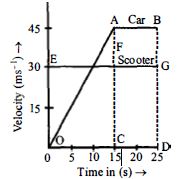
The velocity-time graphs of a car and a scooter are shown in the figure. $(i)$ the difference between the distance travelled by the car and the scooter in $15\, s$ and $(ii)$ the time at which the car will catch up with the scooter are, respectively
If the sun’s surface radiates heat at $6.3 \times {10^7}W{m^{ - 2}}$. Calculate the temperature of the sun assuming it to be a black body $(\sigma = 5.7 \times {10^{ - 8}}W{m^{ - 2}}{K^{ - 4}})$
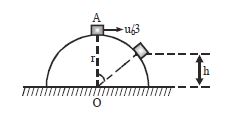
In the given figure for $u\ =\ u_0/3$ , find the height from the ground at which the block leaves the hemisphere [where $u_0\ =\ \sqrt {\frac{{gr}}{3}} ]$
A particle moves in a circle of radius $25\, cm$ at two revolutions per second. The acceleration of the particle in $meter/second^2$ is
A force $F$ is applied on a square area of side $L$. If the percentage error in the measurement of $L$ is $2 \%$ and that in $F$ is $4 \%$, what is the maximum percentage error in pressure?
A particle of mass $m_1$​ moving with a velocity of $5\ m/ s$ collides head on with a stationary particle of mass $m_2$​. After collision both the particle move with a common velocity of $4\ m/ s,$ then the value $m_1 / m_2\ Z$ is:
The vector product of two vectors a and b is a vector c such that c is perpendicular to the plane containing a and b and the direction is given by:
A sphere of mass $m $ moving with a constant velocity $u$ hits another stationary sphere of the same mass. If $e$  is the coefficient of restitution, then the ratio of the velocity of two spheres after collision will be