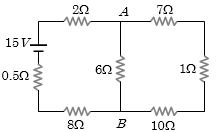
If an electric heater is rated at $1000\, W$, then the time required to heat one litre of water from $20\,^oC$ to $60\,^oC$ is
Medium


Download our appand get started for free
Experience the future of education. Simply download our apps or reach out to us for more information. Let's shape the future of learning together!No signup needed.*
Similar Questions
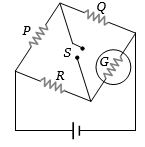
- 1The figure shows a circuit diagram of a ‘Wheatstone Bridge’ to measure the resistance $G$ of the galvanometer. The relation $\frac{P}{Q} = \frac{R}{G}$ will be satisfied only whenView Solution
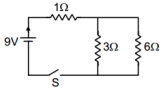
- 2After switch is closed, current drawn from the battery is (in $A$)View Solution
- 3A $5.0\, amp$ current is setup in an external circuit by a $6.0\, volt$ storage battery for $6.0$ minutes. The chemical energy of the battery is reduced byView Solution
- 4$A$ current passes through a wire of nonuniform cross section. Which of the following quantities are independent of the cross-section?View Solution
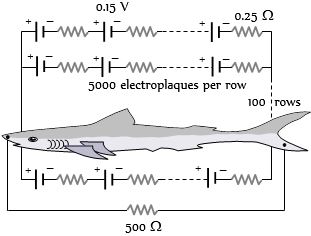
- 5Eels are able to generate current with biological cells called electroplaques. The electroplaques in an eel are arranged in $100$ rows, each row stretching horizontally along the body of the fish containing $5000$ electroplaques. The arrangement is suggestively shown below. Each electroplaques has an emf of $0.15\, V$ and internal resistance of $0.25 \,\Omega$ The water surrounding the eel completes a circuit between the head and its tail. If the water surrounding it has a resistance of $500 \,\Omega$, the current an eel can produce in water is about .............. $A$View Solution
- 6Resistance of rod is calculated by measuring its length with help of meter scale of least count $1\ mm$ . Its radius is measured with help of screw gauge having $50$ division on circular scale and pitch is of $1\ mm$ . Resistivity of material is exact. Length of the wire is found to be $20\ cm$ and diameter of wire is $4\ mm$ . Find the percentage error in calculation of resistance ............... $\%$View Solution
- 7Three copper rods are subjected to different potential difference. Compare the drift speed of electrons through them. Assume that all $3$ are at the same temperature.View Solution
Length Diameter Potential difference $(A)$ $L$ $3d$ $V$ $(B)$ $2L$ $d$ $2V$ $(C)$ $3L$ $2d$ $2V$ - 8The drift velocity of electrons for a conductor connected in an electrical circuit is $V _{ d }$. The conductor in now replaced by another conductor with same material and same length but double the area of cross section. The applied voltage remains same. The new drift velocity of electrons will beView Solution
- 9View SolutionThe capacitor shown in fig. is in steady state. The energy stored in the capacitor is
- 10The current from the battery in circuit diagram shown is .............. $A$View Solution