MCQ
If an electron is accelerated by $8.8 \times 10^{14} m / s ^2$ , then electric field required for acceleration is $($given specific charge of the electron $=1.76 \times 10^{11} Ckg ^{-1} )Z$
  • A
    $52 V cm ^{-1}$
  • $50 V cm ^{-1}$
  • C
    $54 V cm ^{-1}$
  • D
    $56 V cm ^{-1}$

Answer

Correct option: B.
$50 V cm ^{-1}$
$a=8.8 \times 10^{14} m / s ^2$
$\frac{e}{m}=1.76 \times 10^{11} C^{-1} \ kg^{-1}$
$a=\frac{F}{m}=\frac{e E}{m}=\left(\frac{e}{m}\right) E$
$8.8 \times 10^{14}=1.76 \times 10^{11} \times E$
$E=\frac{8.8 \times 10^{14}}{1.76 \times 10^{11}}$
$=5000 Vm ^{-1}$
$=50 Vcm ^{-1}$

Need a full question paper?

Generate a complete, print-ready paper with questions like this in minutes — across 16+ boards, with answer keys.

Start Generating Free

Similar questions

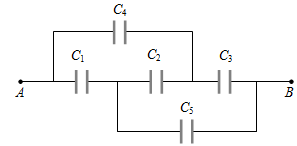
In the given figure the capacitors $C_1,C_3,C_4,C_5$ have a capacitance 4mF each if the capacitor $C_2$ has a capacitance 10mF, then effective capacitance between A and B will be
${}^{238}U$ has $92$ protons and $238$ nucleons. It decays by emitting an Alpha particle and becomes
Given below are two statements: One is labelled as Assertion A and the other is labelled as Reason $R$

Assertion $A:$ The beam of electrons shows wave nature and exhibit interference and diffraction.

Reason $R$ : Davisson Germer Experimentally verified the wave nature of electrons.

In the light of the above statements. Choose the most appropriate answer from the options given below :

Two parallel wires carry currents of 20A and 40A in opposite directions. Another wire carying a current anti parallel to 20A is placed midway between the two wires. T he magnetic force on it will be:
The resistance of the series combination of two resistance is S. When they are joined in parallel the total resistance is P. If S = nP, then the minimum possible value of n is
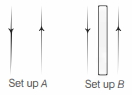
In an experiment, set up $A$ consists of two parallel wires which carry currents in opposite directions as shown in the figure. $A$ second set up $B$ is identical to set up $A$, except that there is a metal plate between the wires. Let $F_A$ and $F_B$ be the magnitude of the force between the two wires in setup $A$ and setup $B$, respectively.
Radio wave diffract around building although light waves do not. The reason is that radio waves
In a current carrying conductor the net charge is:
The spectrum of light emitted by a glowing solid is
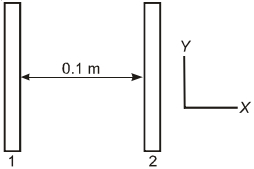
Two insulating plates are both uniformly charged in such a way that the potential difference between them is $V_2 - V_1 = 20\ V$. (i.e., plate $2$ is at a higher potential). The plates are separated by $d = 0.1\ m$ and can be treated as infinitely large. An electron is released from rest on the inner surface of plate $1. $ What is its speed when it hits plate $2?$
$(e = 1.6 \times 10^{-19}\ C, m_e= 9.11 \times 10^{-31}\ kg)$